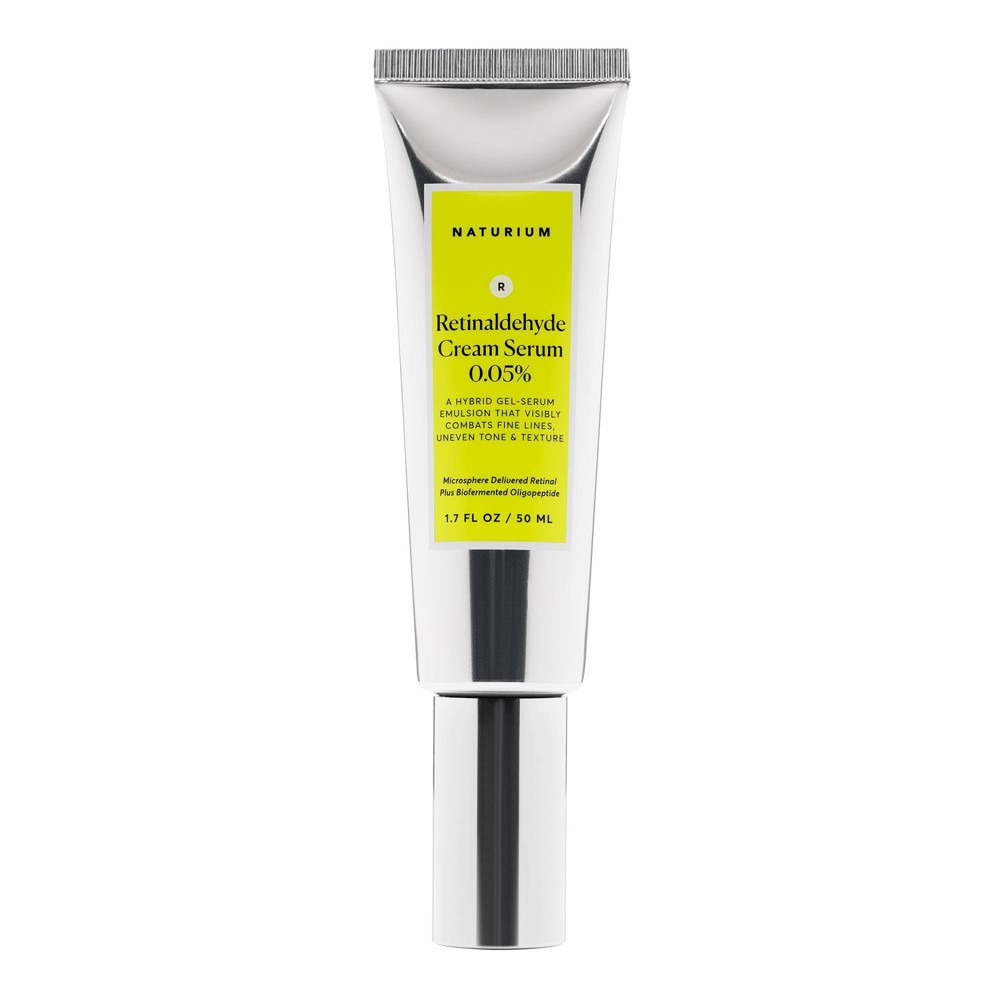
Naturium Retinaldehyde Cream Serum 0.05% - 1.7 fl oz: Anti-Aging, Face Serum, Normal Skin, Unscented
At a glance
Summary
This serum contains beneficial ingredients like glycerin, propanediol, and pomegranate seed extract, which provide moisturizing and antioxidant benefits. However, the presence of phenoxyethanol and sodium metabisulfite, which can cause irritation and allergic reactions in some individuals, slightly lowers its safety profile. The product is mostly composed of safe and effective ingredients, but the inclusion of these preservatives affects its overall rating. Its aluminum packaging has a plastic lining, which costs it a few points.
Key ingredients 37
Punica Granatum Seed ExtractVery Good
Pomegranate seed extract is rich in antioxidants and provides anti-aging benefits. It helps to protect the skin from environmental damage and improve skin texture. It is considered safe and beneficial for most skin types.
Risks
There are minimal risks, though it may cause mild irritation in sensitive individuals.
Benefits
Pomegranate seed extract helps protect the skin and provides anti-aging benefits.
RetinalVery Good
Retinal is a form of vitamin A that provides anti-aging benefits and improves skin texture. It helps to reduce the appearance of fine lines and wrinkles. It is considered safe and beneficial for most skin types.
Risks
Retinal can cause irritation and sensitivity, especially in high concentrations.
Benefits
Retinal helps improve skin texture and provides anti-aging benefits.
TocopherolVery Good
Tocopherol, also known as vitamin E, is an antioxidant that provides skin conditioning benefits. It helps to protect the skin from environmental damage and improve skin texture. It is considered safe and beneficial for most skin types.
Risks
There are minimal risks, though it may cause mild irritation in sensitive individuals.
Benefits
Tocopherol helps protect the skin and provides antioxidant benefits.
GlycerinGood
Glycerin is a humectant that attracts moisture to the skin, helping to keep it hydrated. It is widely used in skincare for its moisturizing properties. It is considered safe and beneficial for most skin types.
Risks
There are minimal risks, though it can be sticky in high concentrations.
Benefits
Glycerin helps maintain skin hydration and improves skin barrier function.
PropanediolGood
Propanediol is a glycol that acts as a solvent and skin-conditioning agent. It enhances the absorption of other ingredients and provides a smooth application. It is generally considered safe and non-irritating.
Risks
In rare cases, it may cause mild irritation or allergic reactions.
Benefits
Propanediol helps improve skin texture and enhances the efficacy of active ingredients.
TriheptanoinGood
Triheptanoin is an emollient that helps to soften and smooth the skin. It is derived from glycerin and fatty acids, providing a lightweight feel. It is considered safe and beneficial for skin conditioning.
Risks
There are minimal risks associated with its use.
Benefits
Triheptanoin helps improve skin texture and provides a non-greasy feel.
Coco-Caprylate/CaprateGood
Coco-Caprylate/Caprate is an emollient derived from coconut oil and caprylic acid. It provides a light, silky feel and enhances skin softness. It is considered safe and beneficial for most skin types.
Risks
There are minimal risks, though it may cause mild irritation in sensitive individuals.
Benefits
Coco-Caprylate/Caprate helps improve skin texture and provides a non-greasy feel.
Faex (Yeast) ExtractGood
Yeast extract is rich in nutrients and antioxidants that can benefit the skin. It helps to improve skin texture and provides anti-aging benefits. It is considered safe and beneficial for most skin types.
Risks
There are minimal risks, though it may cause mild irritation in sensitive individuals.
Benefits
Yeast extract helps improve skin texture and provides antioxidant benefits.
Apricot Kernel Oil Polyglyceryl-6 EstersGood
This ingredient is an emollient derived from apricot kernel oil, providing moisturizing benefits. It helps to soften and smooth the skin. It is considered safe and beneficial for most skin types.
Risks
There are minimal risks, though it may cause mild irritation in sensitive individuals.
Benefits
Apricot Kernel Oil Polyglyceryl-6 Esters help improve skin texture and provide moisturizing benefits.
Soy Amino AcidsGood
Soy amino acids are used for their conditioning properties, helping to improve skin texture. They provide essential nutrients that support skin health. They are considered safe and beneficial for most skin types.
Risks
There are minimal risks, though it may cause mild irritation in sensitive individuals.
Benefits
Soy amino acids help improve skin texture and provide essential nutrients.
Hydrolyzed Yeast ExtractGood
Hydrolyzed yeast extract is rich in nutrients and provides conditioning benefits. It helps to improve skin texture and provides anti-aging benefits. It is considered safe and beneficial for most skin types.
Risks
There are minimal risks, though it may cause mild irritation in sensitive individuals.
Benefits
Hydrolyzed yeast extract helps improve skin texture and provides anti-aging benefits.
Olivine ExtractGood
Olivine extract is rich in minerals and provides antioxidant benefits. It helps to protect the skin from environmental damage and improve skin texture. It is considered safe and beneficial for most skin types.
Risks
There are minimal risks, though it may cause mild irritation in sensitive individuals.
Benefits
Olivine extract helps protect the skin and provides antioxidant benefits.
Adenosine PhosphateGood
Adenosine phosphate is used for its anti-aging and skin-conditioning properties. It helps to improve skin texture and reduce the appearance of fine lines. It is considered safe and beneficial for most skin types.
Risks
There are minimal risks, though it may cause mild irritation in sensitive individuals.
Benefits
Adenosine phosphate helps improve skin texture and provides anti-aging benefits.
Aqua (Water)Neutral
Water is a common solvent used in cosmetic formulations. It helps dissolve other ingredients and provides a base for the serum. It is generally considered safe and non-irritating.
Risks
There are no significant risks associated with water in cosmetics.
Benefits
Water helps hydrate the skin by providing moisture.
C13-15 AlkaneNeutral
C13-15 Alkane is used as an emollient and solvent in cosmetics. It provides a silky feel and helps to spread the product evenly. It is generally considered safe for use in skincare.
Risks
There are minimal risks, though it may cause mild irritation in sensitive individuals.
Benefits
C13-15 Alkane helps improve the texture and application of the product.
CarbomerNeutral
Carbomer is a thickening agent used to stabilize and thicken cosmetic formulations. It helps to create a smooth, gel-like texture. It is generally considered safe for use in cosmetics.
Risks
There are minimal risks, though it may cause mild irritation in sensitive individuals.
Benefits
Carbomer helps improve the texture and stability of the product.
Cetyl Diglyceryl Tris (Trimethylsiloxy) Silylethyl DimethiconeNeutral
This silicone-based ingredient is used as an emollient and conditioning agent. It provides a smooth, silky feel and helps to improve the texture of the product. It is generally considered safe for use in cosmetics.
Risks
There are minimal risks, though it may cause mild irritation in sensitive individuals.
Benefits
This ingredient helps improve the texture and application of the product.
Dilinoleic Acid/Butanediol CopolymerNeutral
This copolymer is used as a film-forming agent and provides conditioning benefits. It helps to improve the texture and application of the product. It is generally considered safe for use in cosmetics.
Risks
There are minimal risks, though it may cause mild irritation in sensitive individuals.
Benefits
This copolymer helps improve the texture and application of the product.
CelluloseNeutral
Cellulose is used as a thickening agent and provides texture to cosmetic formulations. It helps to stabilize the product and improve its consistency. It is generally considered safe for use in cosmetics.
Risks
There are minimal risks, though it may cause mild irritation in sensitive individuals.
Benefits
Cellulose helps improve the texture and stability of the product.
Sorbitan OleateNeutral
Sorbitan oleate is an emulsifier used to stabilize cosmetic formulations. It helps to blend oil and water-based ingredients. It is generally considered safe for use in cosmetics.
Risks
There are minimal risks, though it may cause mild irritation in sensitive individuals.
Benefits
Sorbitan oleate helps improve the stability and texture of the product.
GuanosineNeutral
Guanosine is a nucleoside that provides conditioning benefits in cosmetics. It helps to improve skin texture and hydration. It is generally considered safe for use in cosmetics.
Risks
There are minimal risks, though it may cause mild irritation in sensitive individuals.
Benefits
Guanosine helps improve skin texture and provides hydration benefits.
UracilNeutral
Uracil is a nucleobase that provides conditioning benefits in cosmetics. It helps to improve skin texture and hydration. It is generally considered safe for use in cosmetics.
Risks
There are minimal risks, though it may cause mild irritation in sensitive individuals.
Benefits
Uracil helps improve skin texture and provides hydration benefits.
Polyacrylate Crosspolymer-6Neutral
This ingredient is used as a thickening agent and provides texture to cosmetic formulations. It helps to stabilize the product and improve its consistency. It is generally considered safe for use in cosmetics.
Risks
There are minimal risks, though it may cause mild irritation in sensitive individuals.
Benefits
Polyacrylate Crosspolymer-6 helps improve the texture and stability of the product.
C9-12 AlkaneNeutral
C9-12 Alkane is used as an emollient and solvent in cosmetics. It provides a silky feel and helps to spread the product evenly. It is generally considered safe for use in skincare.
Risks
There are minimal risks, though it may cause mild irritation in sensitive individuals.
Benefits
C9-12 Alkane helps improve the texture and application of the product.
Caprylyl GlycolNeutral
Standard formulation ingredient — neither beneficial nor harmful at typical use.
Risks
There are minimal risks, though it may cause mild irritation in sensitive individuals.
Benefits
Caprylyl glycol helps improve skin hydration and enhances product preservation.
Polyglyceryl-10 DipalmitateNeutral
This ingredient is an emulsifier used to stabilize cosmetic formulations. It helps to blend oil and water-based ingredients. It is generally considered safe for use in cosmetics.
Risks
There are minimal risks, though it may cause mild irritation in sensitive individuals.
Benefits
Polyglyceryl-10 Dipalmitate helps improve the stability and texture of the product.
Dipropylene GlycolNeutral
Dipropylene glycol is a solvent and humectant used in cosmetics. It helps to improve the texture and application of the product. It is generally considered safe for use in cosmetics.
Risks
There are minimal risks, though it may cause mild irritation in sensitive individuals.
Benefits
Dipropylene glycol helps improve skin hydration and product application.
Sodium HydroxideNeutral
Sodium hydroxide is used to adjust the pH of cosmetic formulations. It helps to maintain the stability and efficacy of the product. It is generally considered safe in low concentrations.
Risks
In high concentrations, it can be corrosive and cause irritation.
Benefits
Sodium hydroxide helps maintain the stability and efficacy of the product.
Glyceryl PolyacrylateNeutral
Glyceryl polyacrylate is used as a thickening agent and provides texture to cosmetic formulations. It helps to stabilize the product and improve its consistency. It is generally considered safe for use in cosmetics.
Risks
There are minimal risks, though it may cause mild irritation in sensitive individuals.
Benefits
Glyceryl polyacrylate helps improve the texture and stability of the product.
PVM/MA CopolymerNeutral
PVM/MA copolymer is used as a film-forming agent and provides conditioning benefits. It helps to improve the texture and application of the product. It is generally considered safe for use in cosmetics.
Risks
There are minimal risks, though it may cause mild irritation in sensitive individuals.
Benefits
PVM/MA copolymer helps improve the texture and application of the product.
Castor Oil/IPDI CopolymerNeutral
This copolymer is used as a film-forming agent and provides conditioning benefits. It helps to improve the texture and application of the product. It is generally considered safe for use in cosmetics.
Risks
There are minimal risks, though it may cause mild irritation in sensitive individuals.
Benefits
This copolymer helps improve the texture and application of the product.
HexadeceneNeutral
Hexadecene is used as an emollient and provides a silky feel to cosmetic formulations. It helps to improve the texture and application of the product. It is generally considered safe for use in cosmetics.
Risks
There are minimal risks, though it may cause mild irritation in sensitive individuals.
Benefits
Hexadecene helps improve the texture and application of the product.
T-Butyl AlcoholNeutral
T-Butyl alcohol is used as a solvent and stabilizer in cosmetic formulations. It helps to improve the texture and application of the product. It is generally considered safe for use in cosmetics.
Risks
There are minimal risks, though it may cause mild irritation in sensitive individuals.
Benefits
T-Butyl alcohol helps improve the texture and application of the product.
PhenoxyethanolBad
Phenoxyethanol is a preservative used to prevent microbial growth in cosmetics. It is effective but can cause irritation and allergic reactions in some individuals. It is considered safe in low concentrations but has potential risks.
Risks
Phenoxyethanol can cause skin irritation and allergic reactions, especially in sensitive individuals.
Benefits
It helps preserve the product and extend its shelf life.
Sodium MetabisulfiteBad
Sodium metabisulfite is used as a preservative and antioxidant in cosmetics. It can cause allergic reactions and irritation in some individuals. It is considered safe in low concentrations but has potential risks.
Risks
Sodium metabisulfite can cause allergic reactions and irritation, especially in sensitive individuals.
Benefits
It helps preserve the product and prevent oxidation.
Potassium SorbateBad
Synthetic preservative — flagged in daily-use products.
Risks
In rare cases, it may cause mild irritation or allergic reactions.
Benefits
Potassium sorbate helps preserve the product and extend its shelf life.
Sodium BenzoateBad
Synthetic preservative that can form benzene in the presence of vitamin C.
Risks
In rare cases, it may cause mild irritation or allergic reactions.
Benefits
Sodium benzoate helps preserve the product and extend its shelf life.
Processing
Processed Foods
Get the full breakdown in the Scout appTake Scout shopping
Scan any product to see lab results, healthy alternatives, and your personalized analysis.
Are you Naturium? Fix an error Get the badge Get tested
Amazon pricing & content
Amazon price as of . Product prices and availability are accurate as of the date/time indicated and are subject to change. Any price and availability information displayed on Amazon.com at the time of purchase will apply to the purchase of this product.
CERTAIN CONTENT THAT APPEARS ON THIS SITE COMES FROM AMAZON. THIS CONTENT IS PROVIDED “AS IS” AND IS SUBJECT TO CHANGE OR REMOVAL AT ANY TIME.