
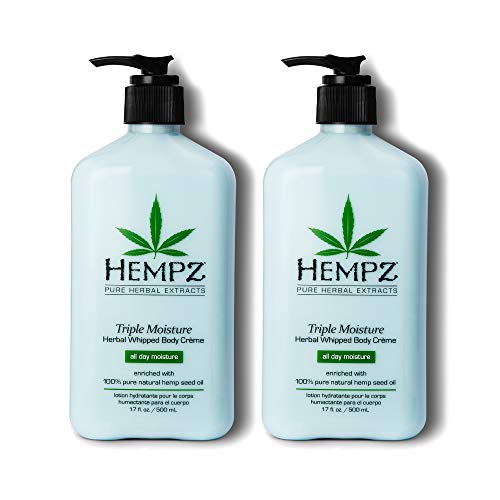
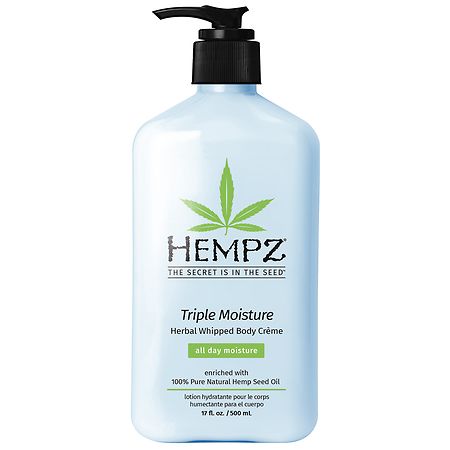


Hempz Triple Moisture Herbal Whipped Body Creme
Analysis updated August 2026 · How Scout scores
At a glance
Summary
This body creme contains several beneficial ingredients such as shea butter, jojoba oil, and cannabis sativa seed oil, which provide moisturizing and soothing benefits. However, the presence of synthetic fragrance, phenoxyethanol, and silicones like cyclopentasiloxane detracts from its overall safety profile, as these can cause skin irritation and have environmental concerns. The product's processing level is moderate, with a mix of natural and synthetic components, leading to a balanced score.
Key ingredients 45
Butyrospermum Parkii (Shea) ButterVery Good
Shea Butter is a natural fat extracted from the nuts of the shea tree. It is rich in vitamins and fatty acids, providing deep moisture and nourishment to the skin. It is highly beneficial for dry and sensitive skin types.
Risks
There are minimal risks, though it may cause allergic reactions in individuals with nut allergies.
Benefits
Shea Butter provides deep moisture and nourishment to the skin.
Cannabis Sativa Seed OilVery Good
Cannabis Sativa Seed Oil is rich in essential fatty acids and antioxidants. It helps to moisturize and soothe the skin, providing anti-inflammatory benefits. It is beneficial for maintaining skin health and reducing irritation.
Risks
There are minimal risks, though it may cause irritation in very sensitive skin.
Benefits
It moisturizes and soothes the skin, providing anti-inflammatory benefits.
Prunus Amygdalus Dulcis (Sweet Almond) OilVery Good
Sweet Almond Oil is a natural emollient rich in vitamins and fatty acids. It helps to moisturize and soften the skin, improving its texture. It is beneficial for dry and sensitive skin types.
Risks
There are minimal risks, though it may cause allergic reactions in individuals with nut allergies.
Benefits
It moisturizes and softens the skin, improving texture.
Helianthus Annuus (Sunflower) Seed OilVery Good
Sunflower Seed Oil is a natural emollient rich in vitamins and fatty acids. It helps to moisturize and protect the skin, providing nourishment. It is beneficial for maintaining healthy skin.
Risks
There are minimal risks associated with this ingredient.
Benefits
It moisturizes and protects the skin, providing nourishment.
Simmondsia Chinensis (Jojoba) Seed OilVery Good
Jojoba Oil is a natural emollient that closely resembles the skin's natural sebum. It helps to balance oil production and moisturize the skin. It is beneficial for all skin types, including oily and acne-prone skin.
Risks
There are minimal risks associated with this ingredient.
Benefits
It balances oil production and moisturizes the skin.
Retinyl PalmitateVery Good
Retinyl Palmitate is a form of Vitamin A used for its anti-aging benefits. It helps to improve skin texture and reduce the appearance of fine lines and wrinkles. It is beneficial for maintaining youthful skin.
Risks
There are minimal risks, though it may cause irritation in very sensitive skin.
Benefits
It improves skin texture and reduces the appearance of fine lines and wrinkles.
TocopherolVery Good
Tocopherol, also known as Vitamin E, is a powerful antioxidant. It helps to protect the skin from environmental damage and improve moisture retention. It is beneficial for maintaining healthy skin.
Risks
There are minimal risks associated with this ingredient.
Benefits
It protects the skin from environmental damage and improves moisture retention.
Caprylic/Capric TriglycerideGood
Caprylic/Capric Triglyceride is an emollient derived from coconut oil and glycerin. It helps to smooth and soften the skin. It is well-tolerated by most skin types and provides a lightweight, non-greasy feel.
Risks
There are minimal risks associated with this ingredient, though it may cause mild irritation in very sensitive individuals.
Benefits
It provides a lightweight, non-greasy feel and helps to smooth and soften the skin.
GlycerinGood
Glycerin is a humectant that attracts moisture to the skin, helping to keep it hydrated. It is widely used in skincare for its moisturizing properties. It is generally safe and effective for all skin types.
Risks
There are no significant risks associated with glycerin in cosmetics.
Benefits
Glycerin helps to keep the skin hydrated by attracting moisture.
Calodendrum Capense Nut OilGood
Calodendrum Capense Nut Oil is an emollient oil that helps to moisturize and condition the skin. It is rich in fatty acids, providing nourishment and improving skin texture. It is generally well-tolerated by most skin types.
Risks
There are minimal risks, though it may cause allergic reactions in individuals with nut allergies.
Benefits
It moisturizes and conditions the skin, improving texture.
Imperata Cylindrica Root ExtractGood
Imperata Cylindrica Root Extract is known for its hydrating properties. It helps to retain moisture in the skin, providing long-lasting hydration. It is beneficial for dry skin types.
Risks
There are minimal risks associated with this ingredient.
Benefits
It provides long-lasting hydration by retaining moisture in the skin.
Terminalia Ferdinandiana Fruit ExtractGood
Terminalia Ferdinandiana Fruit Extract is rich in vitamin C and antioxidants. It helps to brighten the skin and protect against environmental damage. It is beneficial for improving skin tone and texture.
Risks
There are minimal risks, though it may cause irritation in very sensitive skin.
Benefits
It brightens the skin and protects against environmental damage.
Pyrus Malus (Apple) Fruit ExtractGood
Apple Fruit Extract is rich in antioxidants and vitamins. It helps to nourish and revitalize the skin, providing anti-aging benefits. It is beneficial for maintaining healthy skin.
Risks
There are minimal risks associated with this ingredient.
Benefits
It nourishes and revitalizes the skin, providing anti-aging benefits.
Punica Granatum ExtractGood
Pomegranate Extract is rich in antioxidants and vitamins. It helps to protect the skin from environmental damage and improve skin texture. It is beneficial for anti-aging and skin rejuvenation.
Risks
There are minimal risks associated with this ingredient.
Benefits
It protects the skin from environmental damage and improves texture.
Ascorbic AcidGood
Ascorbic Acid, also known as Vitamin C, is a powerful antioxidant. It helps to brighten the skin and protect against environmental damage. It is beneficial for improving skin tone and reducing signs of aging.
Risks
There are minimal risks, though it may cause irritation in very sensitive skin.
Benefits
It brightens the skin and protects against environmental damage.
Tocopheryl AcetateGood
Tocopheryl Acetate is a form of Vitamin E used for its antioxidant properties. It helps to protect the skin from environmental damage and improve moisture retention. It is beneficial for maintaining healthy skin.
Risks
There are minimal risks associated with this ingredient.
Benefits
It protects the skin from environmental damage and improves moisture retention.
Water/Aqua/EauNeutral
Water is a common solvent used in cosmetics to dissolve other ingredients. It helps in the application and absorption of the product. It does not have any direct benefits or risks associated with its use in cosmetics.
Risks
There are no significant risks associated with water in cosmetics.
Benefits
Water helps in the application and absorption of the product.
PropanediolNeutral
Propanediol is a glycol used as a solvent and skin-conditioning agent. It enhances the absorption of other ingredients. It is generally considered safe for use in cosmetics.
Risks
There are minimal risks, though it may cause irritation in sensitive skin.
Benefits
It enhances the absorption of other ingredients and conditions the skin.
Cetearyl AlcoholNeutral
Standard formulation ingredient — neither beneficial nor harmful at typical use.
Risks
There are minimal risks, though it may cause irritation in very sensitive skin.
Benefits
It helps to soften and smooth the skin, acting as an emollient.
Dicaprylyl CarbonateNeutral
Dicaprylyl Carbonate is an emollient that provides a velvety skin feel. It helps to improve the spreadability of the product. It is generally considered safe for use in cosmetics.
Risks
There are minimal risks associated with this ingredient.
Benefits
It provides a velvety skin feel and improves product spreadability.
C12-15 Alkyl BenzoateNeutral
C12-15 Alkyl Benzoate is an emollient ester that provides a silky feel to the skin. It helps to improve the texture and spreadability of the product. It is generally considered safe for use in cosmetics.
Risks
There are minimal risks associated with this ingredient.
Benefits
It provides a silky feel and improves product texture and spreadability.
Vanilla Planifolia Fruit ExtractNeutral
Vanilla Planifolia Fruit Extract is used for its fragrance and antioxidant properties. It provides a pleasant scent and helps to protect the skin from environmental stressors. It is generally considered safe for use in cosmetics.
Risks
There are minimal risks, though it may cause irritation in very sensitive skin.
Benefits
It provides a pleasant scent and antioxidant protection.
TribeheninNeutral
Tribehenin is an emollient and conditioning agent used in cosmetics. It helps to soften and smooth the skin. It is generally considered safe for use in cosmetics.
Risks
There are minimal risks associated with this ingredient.
Benefits
It helps to soften and smooth the skin.
CarbomerNeutral
Carbomer is a thickening agent used to stabilize and thicken cosmetic formulations. It helps to improve the texture and consistency of the product. It is generally considered safe for use in cosmetics.
Risks
There are minimal risks associated with this ingredient.
Benefits
It helps to stabilize and thicken cosmetic formulations.
Benzyl BenzoateNeutral
Benzyl Benzoate is used as a fragrance ingredient and solvent in cosmetics. It provides a pleasant scent and helps to dissolve other ingredients. It is generally considered safe for use in cosmetics.
Risks
There are minimal risks, though it may cause irritation in very sensitive skin.
Benefits
It provides a pleasant scent and helps to dissolve other ingredients.
CyclohexasiloxaneNeutral
Cyclohexasiloxane is a silicone used to provide a smooth application and silky feel. It helps to improve the texture and spreadability of the product. It is generally considered safe for use in cosmetics.
Risks
There are minimal risks, though it may cause build-up on the skin with prolonged use.
Benefits
It provides a smooth application and silky feel.
Caprylhydroxamic AcidNeutral
Caprylhydroxamic Acid is a preservative used to prevent microbial growth in cosmetics. It helps to extend the shelf life of the product. It is generally considered safe for use in cosmetics.
Risks
There are minimal risks associated with this ingredient.
Benefits
It helps to preserve the product by preventing microbial growth.
MethylpropanediolNeutral
Methylpropanediol is a solvent and skin-conditioning agent used in cosmetics. It helps to enhance the absorption of other ingredients. It is generally considered safe for use in cosmetics.
Risks
There are minimal risks associated with this ingredient.
Benefits
It enhances the absorption of other ingredients and conditions the skin.
Trisodium Ethylenediamine DisuccinateNeutral
Trisodium Ethylenediamine Disuccinate is a chelating agent used to stabilize cosmetic formulations. It helps to prevent the degradation of the product by binding metal ions. It is generally considered safe for use in cosmetics.
Risks
There are minimal risks associated with this ingredient.
Benefits
It helps to stabilize the product by binding metal ions.
Laureth-12Neutral
Laureth-12 is an emulsifier and surfactant used in cosmetics. It helps to mix oil and water-based ingredients and improve product texture. It is generally considered safe for use in cosmetics.
Risks
There are minimal risks, though it may cause irritation in very sensitive skin.
Benefits
It helps to mix oil and water-based ingredients and improve product texture.
Amyl CinnamalNeutral
Amyl Cinnamal is a fragrance ingredient that provides a floral scent. It is used to enhance the fragrance profile of cosmetic products. It is generally considered safe for use in cosmetics.
Risks
There are minimal risks, though it may cause irritation in very sensitive skin.
Benefits
It enhances the fragrance profile of cosmetic products.
Hexyl CinnamalNeutral
Hexyl Cinnamal is a fragrance ingredient that provides a floral scent. It is used to enhance the fragrance profile of cosmetic products. It is generally considered safe for use in cosmetics.
Risks
There are minimal risks, though it may cause irritation in very sensitive skin.
Benefits
It enhances the fragrance profile of cosmetic products.
Blue 1 (CI 42090)Neutral
Blue 1 is a synthetic colorant used to impart color to cosmetic products. It is used in small amounts and is generally considered safe for use in cosmetics. It does not have any direct benefits or risks associated with its use in cosmetics.
Risks
There are minimal risks associated with this ingredient.
Benefits
It imparts color to cosmetic products.
Ext. Violet 2 (CI 60730)Neutral
Ext. Violet 2 is a synthetic colorant used to impart color to cosmetic products. It is used in small amounts and is generally considered safe for use in cosmetics. It does not have any direct benefits or risks associated with its use in cosmetics.
Risks
There are minimal risks associated with this ingredient.
Benefits
It imparts color to cosmetic products.
Citric AcidNeutral
Citric Acid is used to adjust the pH of cosmetic formulations. It helps to stabilize the product and ensure its effectiveness. It is generally considered safe for use in cosmetics.
Risks
There are minimal risks associated with this ingredient.
Benefits
It helps to stabilize the product by adjusting its pH.
DimethiconeBad
Occlusive silicone film-former — flagged under clean-beauty doctrine.
Risks
There are minimal risks, though it may cause build-up on the skin with prolonged use.
Benefits
It provides a smooth application and helps to lock in moisture.
PhenoxyethanolBad
Phenoxyethanol is a preservative used to prevent microbial growth in cosmetics. It can cause skin irritation and allergic reactions in some individuals. It is often criticized for its potential to cause adverse skin reactions.
Risks
Phenoxyethanol can cause skin irritation and allergic reactions.
Benefits
It helps to preserve the product by preventing microbial growth.
CyclopentasiloxaneBad
Cyclopentasiloxane is a silicone used to provide a smooth application and silky feel. It can cause build-up on the skin and is a potential environmental pollutant. It is often criticized for its potential to cause adverse skin reactions and environmental concerns.
Risks
Cyclopentasiloxane can cause build-up on the skin and is a potential environmental pollutant.
Benefits
It provides a smooth application and silky feel.
Polysorbate 60Bad
Processed additive flagged under Scout's ingredient doctrine.
Risks
There are minimal risks, though it may cause irritation in very sensitive skin.
Benefits
It helps to stabilize cosmetic formulations by mixing oil and water-based ingredients.
Aminomethyl PropanolBad
Processed additive flagged under Scout's ingredient doctrine.
Risks
There are minimal risks associated with this ingredient.
Benefits
It helps to stabilize the product by adjusting its pH.
LimoneneBad
Limonene is a fragrance ingredient that provides a citrus scent. It can cause skin irritation and allergic reactions, especially in sensitive individuals. It is often criticized for its potential to cause adverse skin reactions.
Risks
Limonene can cause skin irritation and allergic reactions.
Benefits
It provides a citrus scent to the product.
LinaloolBad
Linalool is a fragrance ingredient that provides a floral scent. It can cause skin irritation and allergic reactions, especially in sensitive individuals. It is often criticized for its potential to cause adverse skin reactions.
Risks
Linalool can cause skin irritation and allergic reactions.
Benefits
It provides a floral scent to the product.
Sodium BenzoateBad
Synthetic preservative that can form benzene in the presence of vitamin C.
Risks
There are minimal risks associated with this ingredient.
Benefits
It helps to preserve the product by preventing microbial growth.
Potassium SorbateBad
Synthetic preservative — flagged in daily-use products.
Risks
There are minimal risks associated with this ingredient.
Benefits
It helps to preserve the product by preventing microbial growth.
Fragrance (Parfum)Very Bad
Fragrance is used to impart scent to cosmetic products. It can cause skin irritation and allergic reactions, especially in sensitive individuals. It is often criticized for its potential to cause adverse skin reactions.
Risks
Fragrance can cause skin irritation and allergic reactions.
Benefits
It provides a pleasant scent to the product.
Get the full breakdown in the Scout appTake Scout shopping
Scan any product to see lab results, healthy alternatives, and your personalized analysis.
Download on theApp Store GET IT ONGoogle PlayAmazon pricing & content
Amazon price as of . Product prices and availability are accurate as of the date/time indicated and are subject to change. Any price and availability information displayed on Amazon.com at the time of purchase will apply to the purchase of this product.
CERTAIN CONTENT THAT APPEARS ON THIS SITE COMES FROM AMAZON. THIS CONTENT IS PROVIDED “AS IS” AND IS SUBJECT TO CHANGE OR REMOVAL AT ANY TIME.