
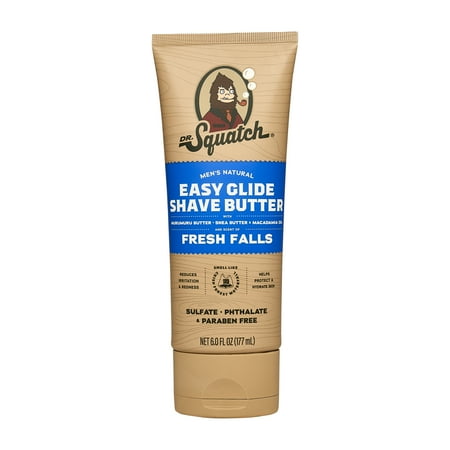
Dr. Squatch Mens Moisturizing Shave Butter Easy Glide Natural Thick & Creamy Shaving Butter for Men Fresh Falls 6 fl Oz
Analysis updated August 2026 · How Scout scores
At a glance
Summary
This shaving butter contains several beneficial ingredients like shea butter, murumuru seed butter, and macadamia seed oil, which provide moisturizing and nourishing properties. However, the presence of 'naturally derived fragrance' is a concern due to potential skin irritation and allergenic risks. The product is moderately processed, which limits its score despite the inclusion of many skin-friendly components.
Key ingredients 30
Butyrospermum Parkii (Shea) ButterVery Good
Shea Butter is a natural fat extracted from the nuts of the shea tree. It is known for its moisturizing and emollient properties, helping to soften and hydrate the skin. It is widely used in skincare for its nourishing benefits.
Risks
There are minimal risks associated with Shea Butter, though individuals with nut allergies should exercise caution.
Benefits
It deeply moisturizes and nourishes the skin, improving its texture and appearance.
Astrocaryum Murumuru Seed ButterVery Good
Murumuru Seed Butter is a natural butter known for its moisturizing and emollient properties. It helps in softening and hydrating the skin, improving its texture. It is considered a beneficial ingredient in skincare.
Risks
There are minimal risks associated with Murumuru Seed Butter, though individuals with nut allergies should exercise caution.
Benefits
It deeply moisturizes and nourishes the skin, enhancing its softness and hydration.
Macadamia Ternifolia Seed OilVery Good
Macadamia Seed Oil is a natural oil rich in fatty acids, known for its moisturizing and nourishing properties. It helps in improving skin hydration and elasticity. It is widely used in skincare for its beneficial effects.
Risks
There are minimal risks associated with Macadamia Seed Oil, though individuals with nut allergies should exercise caution.
Benefits
It provides deep hydration and nourishment, improving skin texture and elasticity.
Coco-GlucosideGood
Coco-Glucoside is a mild surfactant derived from coconut oil and glucose. It is used to cleanse the skin without stripping natural oils. It is considered gentle and suitable for sensitive skin.
Risks
There are minimal risks associated with Coco-Glucoside, though very sensitive individuals might experience mild irritation.
Benefits
It provides gentle cleansing and helps maintain the skin's natural moisture balance.
GlycerinGood
Glycerin is a well-known humectant that attracts moisture to the skin. It helps in keeping the skin hydrated and soft. It is widely used in skincare for its moisturizing properties.
Risks
There are minimal risks associated with glycerin, though it can be sticky in high concentrations.
Benefits
It effectively hydrates the skin and improves its smoothness.
Sodium Cocoyl GlutamateGood
Sodium Cocoyl Glutamate is a mild surfactant derived from coconut oil and glutamic acid. It is used for gentle cleansing and is suitable for sensitive skin. It is considered a safe and effective ingredient in cosmetics.
Risks
There are minimal risks associated with this ingredient, though very sensitive individuals might experience mild irritation.
Benefits
It provides gentle cleansing and helps maintain the skin's natural moisture balance.
Saccharide IsomerateGood
Saccharide Isomerate is a plant-derived moisturizer that binds to the skin and provides long-lasting hydration. It is known for its ability to improve skin smoothness and reduce dryness. It is considered safe and effective in skincare.
Risks
There are minimal risks associated with Saccharide Isomerate, though very sensitive individuals might experience mild irritation.
Benefits
It provides long-lasting hydration and improves skin texture.
Water (Aqua)Neutral
Water is a common solvent used in cosmetic formulations. It helps dissolve other ingredients and provides a base for the product. It does not have any direct benefits or risks.
Risks
There are no significant risks associated with water in cosmetic products.
Benefits
Water helps in the application and spreadability of the product.
Sodium Decylglucosides HydroxypropylsulfonateNeutral
This ingredient is a surfactant used to help cleanse the skin. It is known for being mild and effective in removing dirt and oil. It is generally considered safe for use in cosmetics.
Risks
There are no significant risks associated with this ingredient in typical cosmetic use.
Benefits
It helps in effective cleansing without being overly harsh on the skin.
Myristic AcidNeutral
Myristic Acid is a fatty acid used as an emulsifier and surfactant. It helps in forming a creamy texture and stabilizing the product. It is generally safe for use in cosmetics.
Risks
In rare cases, it may cause mild irritation to very sensitive skin.
Benefits
It contributes to the creamy texture and stability of the product.
Stearic AcidNeutral
Stearic Acid is a fatty acid used as an emulsifier and thickener in cosmetics. It helps in stabilizing formulations and providing a smooth texture. It is generally considered safe for use.
Risks
There are no significant risks associated with Stearic Acid in cosmetic formulations.
Benefits
It helps in maintaining the consistency and stability of the product.
PropanediolNeutral
Propanediol is a glycol used as a solvent and skin-conditioning agent. It helps in improving the texture and feel of the product. It is generally considered safe for use in cosmetics.
Risks
There are no significant risks associated with Propanediol in typical cosmetic use.
Benefits
It enhances the texture and application of the product.
Microcrystalline CelluloseNeutral
Microcrystalline Cellulose is used as a thickener and stabilizer in cosmetic formulations. It helps in maintaining the consistency of the product. It is generally considered safe for use.
Risks
There are no significant risks associated with Microcrystalline Cellulose in cosmetic formulations.
Benefits
It contributes to the stability and texture of the product.
Citric AcidNeutral
Citric Acid is used to adjust the pH of cosmetic formulations. It helps in maintaining the stability and effectiveness of the product. It is generally considered safe for use in cosmetics.
Risks
In high concentrations, it may cause irritation to sensitive skin.
Benefits
It helps in maintaining the pH balance of the product.
Cetearyl AlcoholNeutral
Cetearyl Alcohol is a fatty alcohol used as an emulsifier and thickener. It helps in stabilizing formulations and providing a creamy texture. It is generally considered safe for use in cosmetics.
Risks
There are no significant risks associated with Cetearyl Alcohol in cosmetic formulations.
Benefits
It contributes to the creamy texture and stability of the product.
Cetyl StearateNeutral
Cetyl Stearate is an ester used as an emollient and thickener in cosmetics. It helps in providing a smooth texture and enhancing the feel of the product. It is generally considered safe for use.
Risks
There are no significant risks associated with Cetyl Stearate in cosmetic formulations.
Benefits
It enhances the texture and application of the product.
EthylhexylglycerinNeutral
Ethylhexylglycerin is used as a preservative and skin-conditioning agent. It helps in enhancing the efficacy of other preservatives and provides a smooth feel. It is generally considered safe for use in cosmetics.
Risks
There are no significant risks associated with Ethylhexylglycerin in typical cosmetic use.
Benefits
It helps in preserving the product and improving skin feel.
Titanium DioxideNeutral
Titanium Dioxide is used as a pigment and UV filter in cosmetics. It helps in providing opacity and sun protection. It is generally considered safe for use in cosmetics.
Risks
Inhalation of fine particles can be a concern, but this is less relevant in cream formulations.
Benefits
It provides sun protection and improves the appearance of the product.
Acacia Senegal GumNeutral
Acacia Senegal Gum is used as a thickener and stabilizer in cosmetics. It helps in maintaining the consistency and stability of the product. It is generally considered safe for use.
Risks
There are no significant risks associated with Acacia Senegal Gum in cosmetic formulations.
Benefits
It contributes to the stability and texture of the product.
Cetyl AlcoholNeutral
Cetyl Alcohol is a fatty alcohol used as an emulsifier and thickener. It helps in stabilizing formulations and providing a creamy texture. It is generally considered safe for use in cosmetics.
Risks
There are no significant risks associated with Cetyl Alcohol in cosmetic formulations.
Benefits
It contributes to the creamy texture and stability of the product.
Glycol DistearateNeutral
Glycol Distearate is used as an opacifier and emulsifier in cosmetics. It helps in providing a pearlescent appearance and stabilizing formulations. It is generally considered safe for use.
Risks
There are no significant risks associated with Glycol Distearate in cosmetic formulations.
Benefits
It enhances the appearance and stability of the product.
Xanthan GumNeutral
Xanthan Gum is used as a thickener and stabilizer in cosmetics. It helps in maintaining the consistency and stability of the product. It is generally considered safe for use.
Risks
There are no significant risks associated with Xanthan Gum in cosmetic formulations.
Benefits
It contributes to the stability and texture of the product.
Palmitic AcidNeutral
Palmitic Acid is a fatty acid used as an emulsifier and surfactant in cosmetics. It helps in stabilizing formulations and providing a smooth texture. It is generally considered safe for use.
Risks
There are no significant risks associated with Palmitic Acid in cosmetic formulations.
Benefits
It contributes to the stability and texture of the product.
Cellulose GumNeutral
Cellulose Gum is used as a thickener and stabilizer in cosmetics. It helps in maintaining the consistency and stability of the product. It is generally considered safe for use.
Risks
There are no significant risks associated with Cellulose Gum in cosmetic formulations.
Benefits
It contributes to the stability and texture of the product.
Tetrasodium Glutamate DiacetateNeutral
Tetrasodium Glutamate Diacetate is used as a chelating agent in cosmetics. It helps in enhancing the efficacy of preservatives and stabilizing formulations. It is generally considered safe for use.
Risks
There are no significant risks associated with Tetrasodium Glutamate Diacetate in cosmetic formulations.
Benefits
It helps in preserving the product and enhancing the stability of formulations.
Lauric AcidNeutral
Lauric Acid is a fatty acid used as an emulsifier and surfactant in cosmetics. It helps in stabilizing formulations and providing a smooth texture. It is generally considered safe for use.
Risks
There are no significant risks associated with Lauric Acid in cosmetic formulations.
Benefits
It contributes to the stability and texture of the product.
Arachidic AcidNeutral
Arachidic Acid is a fatty acid used as an emulsifier and surfactant in cosmetics. It helps in stabilizing formulations and providing a smooth texture. It is generally considered safe for use.
Risks
There are no significant risks associated with Arachidic Acid in cosmetic formulations.
Benefits
It contributes to the stability and texture of the product.
Naturally Derived FragranceBad
Fragrance, even when naturally derived, can be a common irritant and allergen in cosmetics. It can cause skin irritation and allergic reactions in sensitive individuals. The exact composition is often undisclosed, making it difficult to assess safety fully.
Risks
Fragrances can cause allergic reactions and irritation, especially in sensitive skin.
Benefits
It provides a pleasant scent to the product, enhancing user experience.
Sodium BenzoateBad
Synthetic preservative that can form benzene in the presence of vitamin C.
Risks
There are no significant risks associated with Sodium Benzoate in typical cosmetic use.
Benefits
It helps in preserving the product and preventing spoilage.
Potassium SorbateBad
Synthetic preservative — flagged in daily-use products.
Risks
There are no significant risks associated with Potassium Sorbate in typical cosmetic use.
Benefits
It helps in preserving the product and preventing spoilage.
Get the full breakdown in the Scout appTake Scout shopping
Scan any product to see lab results, healthy alternatives, and your personalized analysis.
Download on theApp Store GET IT ONGoogle PlayAmazon pricing & content
Amazon price as of . Product prices and availability are accurate as of the date/time indicated and are subject to change. Any price and availability information displayed on Amazon.com at the time of purchase will apply to the purchase of this product.
CERTAIN CONTENT THAT APPEARS ON THIS SITE COMES FROM AMAZON. THIS CONTENT IS PROVIDED “AS IS” AND IS SUBJECT TO CHANGE OR REMOVAL AT ANY TIME.