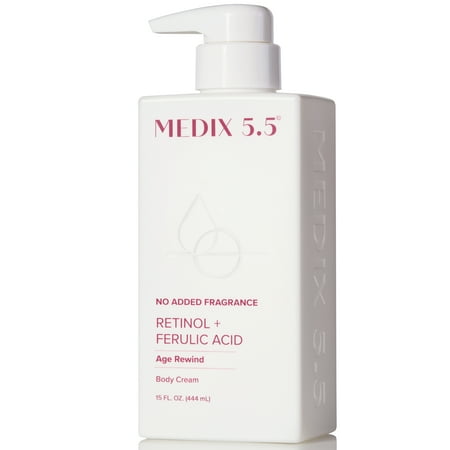
Medix 5.5 Fragrance Free Retinol Body Cream. Anti-Aging Cream for Wrinkle Reduction and Crepey Skin. 15 fl oz
At a glance
Summary
This body cream contains a variety of beneficial ingredients such as shea butter, retinol, and aloe vera, which are known for their moisturizing and anti-aging properties. The presence of natural extracts and antioxidants like ferulic acid and green tea extract further enhance its skin-protective benefits. However, the inclusion of phenoxyethanol as a preservative, which can cause irritation in some individuals, slightly impacts the overall ingredient safety. Its plastic packaging can shed microplastics into the product and lowers its score.
Key ingredients 31
Butyrospermum Parkii (Shea) ButterVery Good
Shea Butter is a natural fat extracted from the nuts of the shea tree, known for its moisturizing and anti-inflammatory properties. It is rich in vitamins and fatty acids, making it beneficial for skin health. It is highly regarded for its ability to nourish and protect the skin.
Risks
Rarely, it may cause allergic reactions in individuals with nut allergies.
Benefits
Deeply moisturizes and soothes the skin, improving elasticity.
Ferulic AcidVery Good
Ferulic Acid is an antioxidant that helps to protect the skin from environmental damage. It enhances the stability and efficacy of other antioxidants like Vitamin C and E. It is beneficial for reducing signs of aging and improving skin health.
Risks
Generally safe with no significant risks.
Benefits
Protects against oxidative stress and enhances skin radiance.
RetinolVery Good
Retinol is a form of Vitamin A known for its anti-aging benefits, including reducing wrinkles and improving skin texture. It promotes cell turnover and collagen production. It is highly effective in improving skin appearance and health.
Risks
Can cause irritation and sensitivity, especially when first introduced.
Benefits
Reduces signs of aging and enhances skin renewal.
Aloe Barbadensis Leaf Juice PowderVery Good
Aloe Vera is known for its soothing and hydrating properties. It helps to calm irritated skin and provides moisture. It is beneficial for all skin types, especially sensitive and dry skin.
Risks
Generally safe with no significant risks.
Benefits
Soothes and hydrates the skin, reducing irritation.
Camellia Sinensis Leaf ExtractVery Good
Green Tea Extract is rich in antioxidants and has anti-inflammatory properties. It helps to protect the skin from environmental damage and reduce redness. It is beneficial for maintaining healthy and youthful skin.
Risks
Generally safe with no significant risks.
Benefits
Protects against oxidative stress and soothes the skin.
TocopherolVery Good
Tocopherol, or Vitamin E, is a powerful antioxidant that helps to protect the skin from free radical damage. It also has moisturizing and healing properties. It is beneficial for improving skin texture and appearance.
Risks
Generally safe with no significant risks.
Benefits
Protects and nourishes the skin, enhancing its resilience.
Anthemis Nobilis (Chamomile) Flower ExtractVery Good
Chamomile Extract is known for its calming and anti-inflammatory properties. It helps to soothe irritated skin and reduce redness. It is beneficial for sensitive and reactive skin types.
Risks
Generally safe with no significant risks.
Benefits
Calms and soothes the skin, reducing irritation.
GlycerinGood
Glycerin is a humectant that attracts moisture to the skin, helping to keep it hydrated. It is widely used in skincare for its moisturizing properties. It is considered safe and beneficial for most skin types.
Risks
Generally safe with no significant risks.
Benefits
Excellent for maintaining skin hydration and improving skin barrier function.
Dipotassium GlycyrrhizateGood
Dipotassium Glycyrrhizate is derived from licorice root and is known for its anti-inflammatory and soothing properties. It helps to reduce redness and irritation in the skin. It is beneficial for sensitive and irritated skin.
Risks
Generally safe with no significant risks.
Benefits
Calms and soothes irritated skin, reducing redness.
Caprylic/Capric TriglycerideGood
Caprylic/Capric Triglyceride is derived from coconut oil and glycerin, used as an emollient and skin-repairing ingredient. It helps to replenish the skin's surface and resist moisture loss. It is lightweight and non-greasy, making it suitable for all skin types.
Risks
Generally safe with no significant risks.
Benefits
Moisturizes and softens the skin without clogging pores.
Pyrus Malus (Apple) Fruit ExtractGood
Apple Fruit Extract is rich in antioxidants and vitamins, providing nourishment and protection to the skin. It helps to improve skin texture and appearance. It is beneficial for maintaining healthy and vibrant skin.
Risks
Generally safe with no significant risks.
Benefits
Nourishes and protects the skin, enhancing its vitality.
Helianthus Annuus (Sunflower) ExtractGood
Sunflower Extract is rich in vitamins and fatty acids, providing moisturizing and protective benefits to the skin. It helps to maintain skin barrier function and hydration. It is beneficial for all skin types.
Risks
Generally safe with no significant risks.
Benefits
Moisturizes and protects the skin, supporting its health.
Rosmarinus Officinalis (Rosemary) Leaf ExtractGood
Rosemary Extract has antioxidant and antimicrobial properties, helping to protect the skin from environmental damage. It also has astringent properties that can help to tone the skin. It is beneficial for maintaining clear and healthy skin.
Risks
Generally safe with no significant risks.
Benefits
Protects and tones the skin, enhancing its clarity.
Oryza Sativa (Rice) Bran ExtractGood
Rice Bran Extract is rich in antioxidants and nutrients, providing moisturizing and protective benefits to the skin. It helps to improve skin texture and tone. It is beneficial for maintaining healthy and radiant skin.
Risks
Generally safe with no significant risks.
Benefits
Moisturizes and protects the skin, enhancing its appearance.
Aqua/Water/EauNeutral
Water is a common solvent used in cosmetics to dissolve other ingredients. It helps in the application and absorption of the product. It does not have any direct benefits or risks.
Benefits
Essential for dissolving and mixing other ingredients.
Cetyl AlcoholNeutral
Cetyl Alcohol is a fatty alcohol used as an emollient and thickener in cosmetics. It helps to soften and smooth the skin. It is generally considered safe and non-irritating.
Risks
Rarely, it may cause mild irritation in sensitive individuals.
Benefits
Helps to moisturize and condition the skin.
Ceteareth-20Neutral
Ceteareth-20 is an emulsifying agent that helps to mix oil and water-based ingredients. It is commonly used in cosmetics to stabilize formulations. It is generally considered safe for use in skincare products.
Risks
May cause irritation in very sensitive skin.
Benefits
Helps to create stable and uniform formulations.
Isopropyl MyristateNeutral
Isopropyl Myristate is an ester used to enhance the absorption of skincare products. It provides a smooth, non-greasy feel. It is generally safe but can be comedogenic for some skin types.
Risks
May clog pores in acne-prone skin.
Benefits
Improves product absorption and texture.
Glyceryl StearateNeutral
Glyceryl Stearate is an emulsifier that helps to blend water and oil components in skincare products. It also acts as a lubricant on the skin's surface, giving it a soft and smooth appearance. It is generally considered safe for use.
Risks
May cause mild irritation in very sensitive skin.
Benefits
Improves product texture and skin feel.
Cetearyl PhosphateNeutral
Cetearyl Phosphate is used as an emulsifier and surfactant in cosmetics. It helps to stabilize formulations and improve texture. It is generally considered safe for use in skincare products.
Risks
Generally safe with no significant risks.
Benefits
Stabilizes and improves the texture of formulations.
CarbomerNeutral
Carbomer is a thickening agent used to create gel-like textures in cosmetics. It helps to stabilize and thicken formulations. It is generally considered safe for use in skincare products.
Risks
Generally safe with no significant risks.
Benefits
Thickens and stabilizes formulations, improving texture.
Caprylyl GlycolNeutral
Caprylyl Glycol is used as a skin conditioning agent and preservative booster. It helps to improve the moisture content of the skin. It is generally considered safe for use in cosmetics.
Risks
Generally safe with no significant risks.
Benefits
Enhances skin moisture and product preservation.
Xanthan GumNeutral
Xanthan Gum is a natural thickening agent used to stabilize and thicken cosmetic formulations. It helps to improve the texture and consistency of products. It is generally considered safe for use in skincare.
Risks
Generally safe with no significant risks.
Benefits
Stabilizes and thickens formulations, enhancing texture.
Sodium HydroxideNeutral
Sodium Hydroxide is used to adjust the pH of cosmetic formulations. It is effective in small amounts but can be irritating in higher concentrations. It is generally considered safe when used appropriately.
Risks
Can cause irritation if used in high concentrations.
Benefits
Adjusts pH to ensure product stability and efficacy.
EthylhexylglycerinNeutral
Ethylhexylglycerin is used as a skin conditioning agent and preservative enhancer. It helps to improve the efficacy of preservatives and maintain skin moisture. It is generally considered safe for use in cosmetics.
Risks
Generally safe with no significant risks.
Benefits
Enhances preservation and skin conditioning.
Hexylene GlycolNeutral
Hexylene Glycol is used as a solvent and viscosity agent in cosmetics. It helps to improve the texture and spreadability of products. It is generally considered safe for use in skincare.
Risks
Generally safe with no significant risks.
Benefits
Improves texture and spreadability of formulations.
Tetrasodium Glutamate DiacetateNeutral
Tetrasodium Glutamate Diacetate is a chelating agent used to enhance the stability and efficacy of preservatives. It helps to prevent the degradation of cosmetic formulations. It is generally considered safe for use in skincare products.
Risks
Generally safe with no significant risks.
Benefits
Enhances preservation and stability of formulations.
DimethiconeBad
Occlusive silicone film-former — flagged under clean-beauty doctrine.
Risks
May cause breakouts in very sensitive or acne-prone skin.
Benefits
Provides a smooth application and helps to lock in moisture.
PhenoxyethanolBad
Phenoxyethanol is a preservative used to prevent microbial growth in cosmetics. It is effective but can cause irritation and allergic reactions in some individuals. It is considered a moderate risk ingredient in skincare.
Risks
May cause irritation and allergic reactions, especially in sensitive skin.
Benefits
Prevents microbial growth, extending product shelf life.
Synthetic BeeswaxBad
Processed additive flagged under Scout's ingredient doctrine.
Risks
Generally safe with no significant risks.
Benefits
Provides texture and moisture to formulations.
BHTBad
Processed additive flagged under Scout's ingredient doctrine.
Risks
Potential health concerns at high concentrations, but generally safe in cosmetics.
Benefits
Prevents oxidation and extends product shelf life.
Get the full breakdown in the Scout appTake Scout shopping
Scan any product to see lab results, healthy alternatives, and your personalized analysis.
Are you Medix 5.5? Fix an error Get the badge Get tested
Amazon pricing & content
Amazon price as of . Product prices and availability are accurate as of the date/time indicated and are subject to change. Any price and availability information displayed on Amazon.com at the time of purchase will apply to the purchase of this product.
CERTAIN CONTENT THAT APPEARS ON THIS SITE COMES FROM AMAZON. THIS CONTENT IS PROVIDED “AS IS” AND IS SUBJECT TO CHANGE OR REMOVAL AT ANY TIME.