
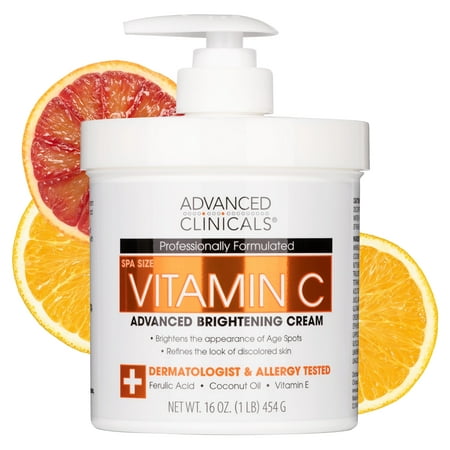

Advanced Clinicals Vitamin C Body Cream for Radiant Skin. 16 OZ
Analysis updated August 2026 · How Scout scores
At a glance
Summary
This body cream contains beneficial ingredients such as various forms of Vitamin C, coconut oil, and glycerin, which provide antioxidant protection and deep hydration. However, the presence of mineral oil and synthetic fragrance can be concerning due to potential skin irritation and contamination risks. The product's processing level is moderate, with a mix of natural and synthetic components, which affects its overall safety profile.
Key ingredients 36
Cocos Nucifera (Coconut) OilVery Good
Coconut Oil is a natural emollient that provides deep hydration and nourishment to the skin. It contains fatty acids that help to improve skin barrier function. It is highly beneficial for dry and sensitive skin types.
Risks
May cause breakouts in acne-prone skin due to its comedogenic nature.
Benefits
Rich in fatty acids, it deeply moisturizes and nourishes the skin.
Aminopropyl Ascorbyl PhosphateVery Good
Aminopropyl Ascorbyl Phosphate is a stable form of Vitamin C that provides antioxidant protection. It helps to brighten the skin and reduce signs of aging. It is effective in improving skin tone and texture.
Risks
Low risk of irritation in sensitive skin.
Benefits
Brightens skin and provides antioxidant protection.
Tetrahexyldecyl AscorbateVery Good
Tetrahexyldecyl Ascorbate is a stable, oil-soluble form of Vitamin C. It penetrates the skin effectively to provide antioxidant benefits. It helps to brighten the skin and reduce the appearance of fine lines.
Risks
Minimal risk of irritation.
Benefits
Enhances skin brightness and provides antioxidant protection.
Ferulic AcidVery Good
Ferulic Acid is an antioxidant that enhances the stability and efficacy of other antioxidants like Vitamin C. It helps to protect the skin from environmental damage. It is beneficial in reducing the appearance of fine lines and wrinkles.
Risks
Low risk of irritation.
Benefits
Boosts antioxidant efficacy and protects against environmental damage.
Aloe Barbadensis Leaf Juice PowderVery Good
Aloe Vera is known for its soothing and hydrating properties. It helps to calm irritated skin and provide moisture. It is beneficial for all skin types, especially sensitive and dry skin.
Risks
Very low risk of irritation.
Benefits
Soothes and hydrates the skin effectively.
Camellia Sinensis Leaf ExtractVery Good
Green Tea Extract is rich in antioxidants that help to protect the skin from environmental damage. It has anti-inflammatory properties that soothe the skin. It is beneficial in reducing redness and irritation.
Risks
Minimal risk of irritation.
Benefits
Provides antioxidant protection and soothes the skin.
GlycerinGood
Glycerin is a powerful humectant that attracts moisture to the skin. It helps to maintain skin hydration and improve barrier function. It is well-tolerated by most skin types.
Risks
Very low risk of irritation.
Benefits
Highly effective in keeping the skin hydrated and supple.
Caprylic/Capric TriglycerideGood
Caprylic/Capric Triglyceride is an emollient derived from coconut oil and glycerin. It helps to moisturize and replenish the skin. It is lightweight and non-greasy, making it suitable for all skin types.
Risks
Minimal risk of irritation or allergic reaction.
Benefits
Provides lightweight hydration and improves skin texture.
Ascorbic AcidGood
Ascorbic Acid is a potent form of Vitamin C known for its antioxidant properties. It helps to protect the skin from environmental damage and improve skin tone. It is effective in reducing signs of aging.
Risks
May cause irritation in sensitive skin types.
Benefits
Provides strong antioxidant protection and improves skin tone.
Tocopheryl AcetateGood
Tocopheryl Acetate is a form of Vitamin E that provides antioxidant benefits. It helps to protect the skin from free radical damage and improve moisture retention. It is well-tolerated by most skin types.
Risks
Minimal risk of irritation.
Benefits
Provides antioxidant protection and improves skin hydration.
TocopherolGood
Tocopherol, or Vitamin E, is an antioxidant that helps to protect the skin from free radical damage. It also improves skin hydration and barrier function. It is well-tolerated by most skin types.
Risks
Minimal risk of irritation.
Benefits
Provides antioxidant protection and improves skin hydration.
Aqua/Water/EauNeutral
Water is a common solvent used in cosmetics to dissolve other ingredients. It helps in the application and absorption of the product. It does not provide direct benefits or risks.
Benefits
Essential for dissolving and mixing other ingredients.
Cetearyl AlcoholNeutral
Cetearyl Alcohol is a fatty alcohol used as an emollient and thickener. It helps to soften and smooth the skin. It is generally considered safe and non-irritating.
Risks
Rarely, it may cause mild irritation in sensitive individuals.
Benefits
Helps to improve the texture and feel of the skin.
Glyceryl Stearate SENeutral
Glyceryl Stearate SE is an emulsifier that helps to blend water and oils. It also acts as a skin conditioning agent. It is generally considered safe for use in cosmetics.
Risks
Minimal risk of irritation or allergic reaction.
Benefits
Improves product texture and helps maintain skin hydration.
Isopropyl MyristateNeutral
Isopropyl Myristate is used to enhance the absorption of other ingredients. It provides a smooth, silky feel to the skin. It is generally safe but can be comedogenic for some skin types.
Risks
Potential to clog pores and cause acne in susceptible individuals.
Benefits
Improves product spreadability and absorption.
Butylene GlycolNeutral
Butylene Glycol is a humectant that helps to retain moisture in the skin. It also improves the texture and spreadability of the product. It is generally considered safe for use in cosmetics.
Risks
Low risk of irritation or allergic reaction.
Benefits
Helps to keep the skin hydrated and improves product application.
Ceteareth-20Neutral
Ceteareth-20 is an emulsifier that helps to mix oil and water components. It improves the texture and stability of the product. It is generally safe but can be irritating to very sensitive skin.
Risks
Potential for mild irritation in sensitive individuals.
Benefits
Enhances product stability and texture.
Tetrasodium Glutamate DiacetateNeutral
Tetrasodium Glutamate Diacetate is a chelating agent that helps to stabilize the product. It binds metal ions to prevent them from affecting the product's stability. It is generally considered safe for use in cosmetics.
Risks
Low risk of irritation.
Benefits
Improves product stability and shelf life.
Sodium PolyacrylateNeutral
Sodium Polyacrylate is used as a thickening and film-forming agent. It helps to improve the texture and stability of the product. It is generally considered safe for use in cosmetics.
Risks
Low risk of irritation.
Benefits
Improves product texture and stability.
Ethylhexyl StearateNeutral
Ethylhexyl Stearate is an emollient that provides a smooth, silky feel to the skin. It helps to improve the spreadability of the product. It is generally considered safe for use in cosmetics.
Risks
Low risk of irritation.
Benefits
Enhances product spreadability and provides a smooth feel.
Trideceth-6Neutral
Trideceth-6 is a surfactant and emulsifier that helps to blend ingredients. It improves the texture and stability of the product. It is generally considered safe for use in cosmetics.
Risks
Low risk of irritation.
Benefits
Improves product texture and stability.
Caprylyl GlycolNeutral
Caprylyl Glycol is a humectant and skin conditioning agent. It helps to retain moisture and improve the texture of the product. It is generally considered safe for use in cosmetics.
Risks
Low risk of irritation.
Benefits
Helps to keep the skin hydrated and improves product texture.
EthylhexylglycerinNeutral
Ethylhexylglycerin is a conditioning agent and preservative enhancer. It helps to improve the efficacy of preservatives and provides skin conditioning benefits. It is generally considered safe for use in cosmetics.
Risks
Low risk of irritation.
Benefits
Enhances preservative efficacy and conditions the skin.
Hexylene GlycolNeutral
Hexylene Glycol is a solvent and viscosity agent used in cosmetics. It helps to improve the texture and spreadability of the product. It is generally considered safe for use in cosmetics.
Risks
Low risk of irritation.
Benefits
Improves product texture and spreadability.
Sodium HydroxideNeutral
Sodium Hydroxide is used to adjust the pH of cosmetic products. It helps to maintain the stability and efficacy of the formulation. It is generally considered safe in low concentrations.
Risks
Can be irritating in high concentrations.
Benefits
Helps to maintain product stability and efficacy.
Benzyl BenzoateNeutral
Benzyl Benzoate is used as a fragrance ingredient and solvent. It helps to dissolve other ingredients and provide a pleasant scent. It is generally considered safe but can cause irritation in sensitive individuals.
Risks
Potential for irritation, especially in sensitive skin.
Benefits
Provides a pleasant scent and helps dissolve other ingredients.
Hexyl CinnamalNeutral
Hexyl Cinnamal is a fragrance ingredient used to impart a floral scent. It is commonly used in cosmetics for its pleasant aroma. It is generally considered safe but can cause allergic reactions in sensitive individuals.
Risks
Potential for allergic reactions.
Benefits
Provides a floral scent to the product.
CitronellolNeutral
Citronellol is a fragrance ingredient that provides a fresh, floral scent. It is commonly used in cosmetics for its pleasant aroma. It is generally considered safe but can cause irritation in sensitive skin.
Risks
Potential for irritation and allergic reactions.
Benefits
Provides a fresh, floral scent to the product.
GeraniolNeutral
Geraniol is a fragrance ingredient that provides a rose-like scent. It is commonly used in cosmetics for its pleasant aroma. It is generally considered safe but can cause irritation in sensitive skin.
Risks
Potential for irritation and allergic reactions.
Benefits
Provides a rose-like scent to the product.
CoumarinNeutral
Coumarin is a fragrance ingredient that provides a sweet, vanilla-like scent. It is commonly used in cosmetics for its pleasant aroma. It is generally considered safe but can cause irritation in sensitive skin.
Risks
Potential for irritation and allergic reactions.
Benefits
Provides a sweet, vanilla-like scent to the product.
Mineral Oil/Huile MinéraleBad
Processed additive flagged under Scout's ingredient doctrine.
Risks
May cause breakouts in acne-prone skin due to its occlusive nature.
Benefits
Effective in preventing moisture loss and keeping skin hydrated.
Acrylates/C10-30 Alkyl Acrylate CrosspolymerBad
Processed additive flagged under Scout's ingredient doctrine.
Risks
Low risk of irritation.
Benefits
Enhances product texture and stability.
PhenoxyethanolBad
Processed additive flagged under Scout's ingredient doctrine.
Risks
Potential for irritation, especially in sensitive skin.
Benefits
Prevents microbial growth and extends product shelf life.
LimoneneBad
Processed additive flagged under Scout's ingredient doctrine.
Risks
Potential for irritation and allergic reactions.
Benefits
Provides a fresh, citrus scent.
LinaloolBad
Processed additive flagged under Scout's ingredient doctrine.
Risks
Potential for irritation and allergic reactions.
Benefits
Provides a floral scent to the product.
Parfum/FragranceVery Bad
Fragrance is used to provide a pleasant scent to the product. However, it can be irritating to sensitive skin and may cause allergic reactions. It is often criticized for its potential to cause skin sensitization.
Risks
High risk of irritation and allergic reactions in sensitive individuals.
Benefits
Provides a pleasant scent to the product.
Get the full breakdown in the Scout appTake Scout shopping
Scan any product to see lab results, healthy alternatives, and your personalized analysis.
Download on theApp Store GET IT ONGoogle PlayAmazon pricing & content
Amazon price as of . Product prices and availability are accurate as of the date/time indicated and are subject to change. Any price and availability information displayed on Amazon.com at the time of purchase will apply to the purchase of this product.
CERTAIN CONTENT THAT APPEARS ON THIS SITE COMES FROM AMAZON. THIS CONTENT IS PROVIDED “AS IS” AND IS SUBJECT TO CHANGE OR REMOVAL AT ANY TIME.