
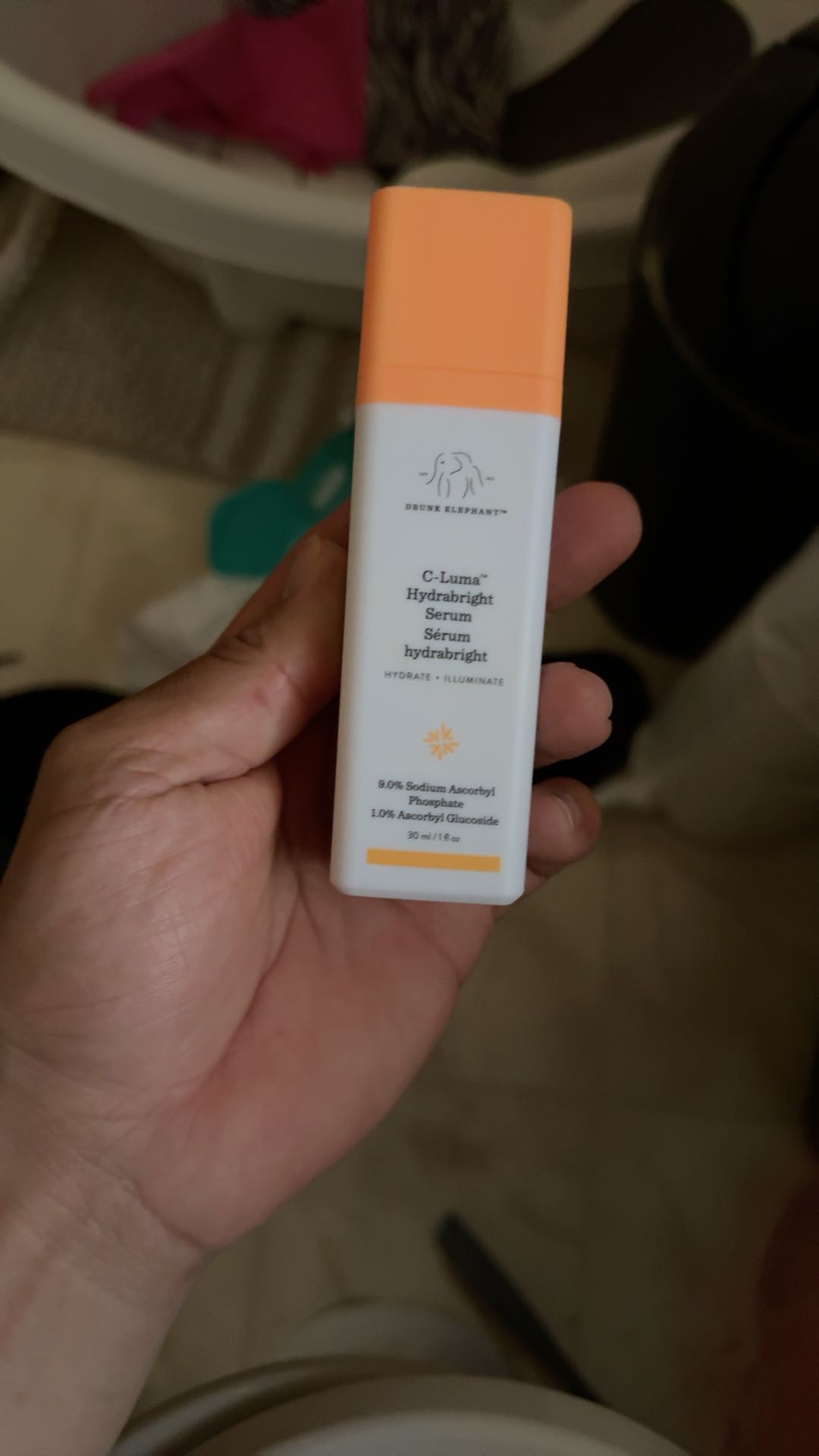



Drunk Elephant C-Luma Hydrabright Gentle Hydrating Vitamin C Serum, Size: 1 Oz, None
Analysis updated August 2026 · How Scout scores
At a glance
Summary
This serum contains several beneficial ingredients like Sodium Ascorbyl Phosphate, Squalane, and Marula Oil, which provide antioxidant benefits and deep hydration. However, the presence of Sodium Metabisulfite, a potential irritant, and the use of synthetic polymers slightly detract from its overall safety profile. The product is moderately processed, which also influences its rating.
Key ingredients 36
Sodium Ascorbyl PhosphateVery Good
Sodium Ascorbyl Phosphate is a stable form of Vitamin C used for its antioxidant properties. It helps in brightening the skin and reducing signs of aging. It is well-tolerated by most skin types.
Risks
There are minimal risks, though it may cause irritation in very sensitive skin.
Benefits
It provides antioxidant protection and helps in collagen synthesis.
SqualaneVery Good
Squalane is a highly effective emollient and natural antioxidant. It mimics the skin's natural oils, making it an excellent moisturizer. It is suitable for all skin types, including sensitive skin.
Risks
There are no significant risks associated with squalane.
Benefits
It provides deep hydration and helps in maintaining skin elasticity.
Ascorbyl GlucosideVery Good
Ascorbyl Glucoside is a stable form of Vitamin C that provides antioxidant benefits. It helps in brightening the skin and reducing signs of aging. It is suitable for most skin types.
Risks
There are minimal risks, though it may cause irritation in very sensitive skin.
Benefits
It provides antioxidant protection and helps in collagen synthesis.
Sclerocarya Birrea Seed OilVery Good
Sclerocarya Birrea Seed Oil, also known as Marula Oil, is rich in antioxidants and fatty acids. It provides deep hydration and helps in improving skin elasticity. It is suitable for all skin types.
Risks
There are no significant risks associated with Marula Oil.
Benefits
It provides nourishment and helps in maintaining skin hydration.
GlutathioneVery Good
The body's master antioxidant tripeptide — supports cellular glutathione status, detoxification pathways and oxidative-stress defense.
Risks
There are minimal risks, though it may cause irritation in very sensitive skin.
Benefits
It provides antioxidant protection and helps in brightening the skin.
GlycerinGood
Glycerin is a humectant that attracts moisture to the skin, keeping it hydrated. It is widely used in skincare for its moisturizing properties. It is safe and effective for all skin types.
Risks
There are no significant risks associated with glycerin.
Benefits
It helps in maintaining skin hydration and improving skin barrier function.
Sodium HyaluronateGood
Sodium Hyaluronate is a form of hyaluronic acid that provides intense hydration. It helps in retaining moisture and improving skin elasticity. It is suitable for all skin types.
Risks
There are no significant risks associated with Sodium Hyaluronate.
Benefits
It provides deep hydration and helps in maintaining skin elasticity.
GluconolactoneGood
Beneficial ingredient — whole-food or functional value in this product class.
Risks
There are minimal risks, though it may cause irritation in very sensitive skin.
Benefits
It provides gentle exfoliation and helps in improving skin texture.
Tocopheryl AcetateGood
Beneficial ingredient — whole-food or functional value in this product class.
Risks
There are minimal risks, though it may cause irritation in very sensitive skin.
Benefits
It provides antioxidant protection and helps in maintaining skin health.
Water/Aqua/EauNeutral
Water is a common solvent used in cosmetics to dissolve other ingredients. It helps in the application and absorption of the product. It does not provide any direct benefits or risks.
Risks
There are no significant risks associated with water in cosmetics.
Benefits
Water helps in the even distribution of other active ingredients.
PropanediolNeutral
Propanediol is a glycol used as a solvent and skin-conditioning agent. It enhances the absorption of ingredients into the skin. It is generally considered safe and non-irritating.
Risks
Propanediol can cause irritation in sensitive skin types.
Benefits
It helps in improving the texture and feel of the product on the skin.
Isodecyl NeopentanoateNeutral
Isodecyl Neopentanoate is an emollient that provides a smooth feel to the skin. It helps in improving the texture of the product. It is generally considered safe for use in cosmetics.
Risks
It may cause mild irritation in very sensitive skin.
Benefits
It enhances the spreadability and feel of the product on the skin.
Neopentyl Glycol DiheptanoateNeutral
Neopentyl Glycol Diheptanoate is used as an emollient and texture enhancer in cosmetics. It provides a silky feel to the skin. It is considered safe for use in skincare products.
Risks
It may cause mild irritation in sensitive individuals.
Benefits
It improves the texture and application of the product.
C9-12 AlkaneNeutral
C9-12 Alkane is used as an emollient and solvent in cosmetics. It helps in improving the spreadability of the product. It is generally considered safe for use in skincare.
Risks
There are minimal risks associated with its use.
Benefits
It enhances the texture and feel of the product on the skin.
Sodium Polyacryloyldimethyl TaurateNeutral
Sodium Polyacryloyldimethyl Taurate is a thickening agent used to stabilize emulsions. It helps in maintaining the consistency of the product. It is considered safe for use in cosmetics.
Risks
There are no significant risks associated with this ingredient.
Benefits
It helps in maintaining the stability and texture of the product.
Coco-Caprylate/CaprateNeutral
Coco-Caprylate/Caprate is an emollient derived from coconut oil. It provides a lightweight feel and enhances the spreadability of the product. It is considered safe for use in cosmetics.
Risks
There are minimal risks associated with its use.
Benefits
It improves the texture and application of the product.
PullulanNeutral
Pullulan is a polysaccharide used as a film-forming agent in cosmetics. It helps in providing a smooth texture to the product. It is considered safe for use in skincare.
Risks
There are no significant risks associated with Pullulan.
Benefits
It helps in improving the texture and feel of the product.
Sclerotium GumNeutral
Sclerotium Gum is a natural thickening agent used to stabilize emulsions. It helps in maintaining the consistency of the product. It is considered safe for use in cosmetics.
Risks
There are no significant risks associated with Sclerotium Gum.
Benefits
It helps in maintaining the stability and texture of the product.
Diglucosyl Gallic AcidNeutral
Diglucosyl Gallic Acid is used for its skin-brightening properties. It helps in reducing hyperpigmentation and improving skin tone. It is considered safe for use in cosmetics.
Risks
There are minimal risks, though it may cause irritation in very sensitive skin.
Benefits
It helps in brightening the skin and reducing dark spots.
Sorbitan SesquiisostearateNeutral
Sorbitan Sesquiisostearate is an emulsifier used to stabilize formulations. It helps in maintaining the consistency of the product. It is considered safe for use in cosmetics.
Risks
There are no significant risks associated with this ingredient.
Benefits
It helps in maintaining the stability and texture of the product.
Sorbeth-30 TetraisostearateNeutral
Sorbeth-30 Tetraisostearate is an emulsifier used to stabilize formulations. It helps in maintaining the consistency of the product. It is considered safe for use in cosmetics.
Risks
There are no significant risks associated with this ingredient.
Benefits
It helps in maintaining the stability and texture of the product.
Dipropylene GlycolNeutral
Dipropylene Glycol is a solvent used to improve the texture and spreadability of the product. It helps in the absorption of other ingredients. It is generally considered safe for use in cosmetics.
Risks
There are minimal risks, though it may cause irritation in very sensitive skin.
Benefits
It enhances the texture and application of the product.
PhloretinNeutral
Phloretin is an antioxidant that helps in reducing oxidative stress on the skin. It is used for its skin-brightening properties. It is generally considered safe for use in cosmetics.
Risks
There are minimal risks, though it may cause irritation in very sensitive skin.
Benefits
It provides antioxidant protection and helps in brightening the skin.
Sodium CitrateNeutral
Sodium Citrate is used as a buffering agent to maintain the pH of the product. It helps in stabilizing the formulation. It is considered safe for use in cosmetics.
Risks
There are no significant risks associated with Sodium Citrate.
Benefits
It helps in maintaining the stability and pH of the product.
PPG-8-Ceteth-20Neutral
PPG-8-Ceteth-20 is an emulsifier used to stabilize formulations. It helps in maintaining the consistency of the product. It is considered safe for use in cosmetics.
Risks
There are no significant risks associated with this ingredient.
Benefits
It helps in maintaining the stability and texture of the product.
Acrylates/Beheneth-25 Methacrylate CopolymerNeutral
Acrylates/Beheneth-25 Methacrylate Copolymer is used as a film-forming agent in cosmetics. It helps in providing a smooth texture to the product. It is considered safe for use in skincare.
Risks
There are no significant risks associated with this ingredient.
Benefits
It helps in improving the texture and feel of the product.
Citric AcidNeutral
Citric Acid is used as a pH adjuster and exfoliant in cosmetics. It helps in maintaining the stability of the product. It is generally considered safe for use in skincare.
Risks
There are minimal risks, though it may cause irritation in very sensitive skin.
Benefits
It helps in maintaining the pH balance and provides mild exfoliation.
Tetrasodium Glutamate DiacetateNeutral
Tetrasodium Glutamate Diacetate is a chelating agent used to enhance the efficacy of preservatives. It helps in stabilizing the formulation. It is considered safe for use in cosmetics.
Risks
There are no significant risks associated with this ingredient.
Benefits
It helps in maintaining the stability and efficacy of the product.
SilicaNeutral
Silica is used as an absorbent and anti-caking agent in cosmetics. It helps in improving the texture and feel of the product. It is generally considered safe for use in skincare.
Risks
There are no significant risks associated with Silica.
Benefits
It helps in improving the texture and application of the product.
Xanthan GumNeutral
Xanthan Gum is a natural thickening agent used to stabilize emulsions. It helps in maintaining the consistency of the product. It is considered safe for use in cosmetics.
Risks
There are no significant risks associated with Xanthan Gum.
Benefits
It helps in maintaining the stability and texture of the product.
Sodium HydroxideNeutral
Sodium Hydroxide is used as a pH adjuster in cosmetics. It helps in maintaining the stability of the product. It is generally considered safe for use in skincare when used in low concentrations.
Risks
High concentrations can be irritating, but it is typically used in safe amounts.
Benefits
It helps in maintaining the pH balance of the product.
Chondrus Crispus ExtractNeutral
Chondrus Crispus Extract, also known as Carrageenan, is used as a thickening agent in cosmetics. It helps in maintaining the consistency of the product. It is considered safe for use in skincare.
Risks
There are no significant risks associated with Chondrus Crispus Extract.
Benefits
It helps in maintaining the stability and texture of the product.
Sodium MetabisulfiteBad
Sodium Metabisulfite is used as a preservative and antioxidant in cosmetics. It can cause allergic reactions and irritation in some individuals. It is considered a potential irritant, especially for sensitive skin.
Risks
It may cause allergic reactions and irritation, particularly in sensitive individuals.
Benefits
It helps in preserving the product and preventing oxidation.
LecithinBad
Processed additive flagged under Scout's ingredient doctrine.
Risks
There are no significant risks associated with Lecithin.
Benefits
It helps in maintaining the stability and texture of the product.
PhenoxyethanolBad
Processed additive flagged under Scout's ingredient doctrine.
Risks
It can cause irritation in sensitive skin types.
Benefits
It helps in preserving the product and preventing contamination.
Sodium BenzoateBad
Synthetic preservative that can form benzene in the presence of vitamin C.
Risks
It can cause irritation in sensitive skin types.
Benefits
It helps in preserving the product and preventing contamination.
Processing
Processed Foods
Get the full breakdown in the Scout appTake Scout shopping
Scan any product to see lab results, healthy alternatives, and your personalized analysis.
Download on theApp Store GET IT ONGoogle PlayAmazon pricing & content
Amazon price as of . Product prices and availability are accurate as of the date/time indicated and are subject to change. Any price and availability information displayed on Amazon.com at the time of purchase will apply to the purchase of this product.
CERTAIN CONTENT THAT APPEARS ON THIS SITE COMES FROM AMAZON. THIS CONTENT IS PROVIDED “AS IS” AND IS SUBJECT TO CHANGE OR REMOVAL AT ANY TIME.