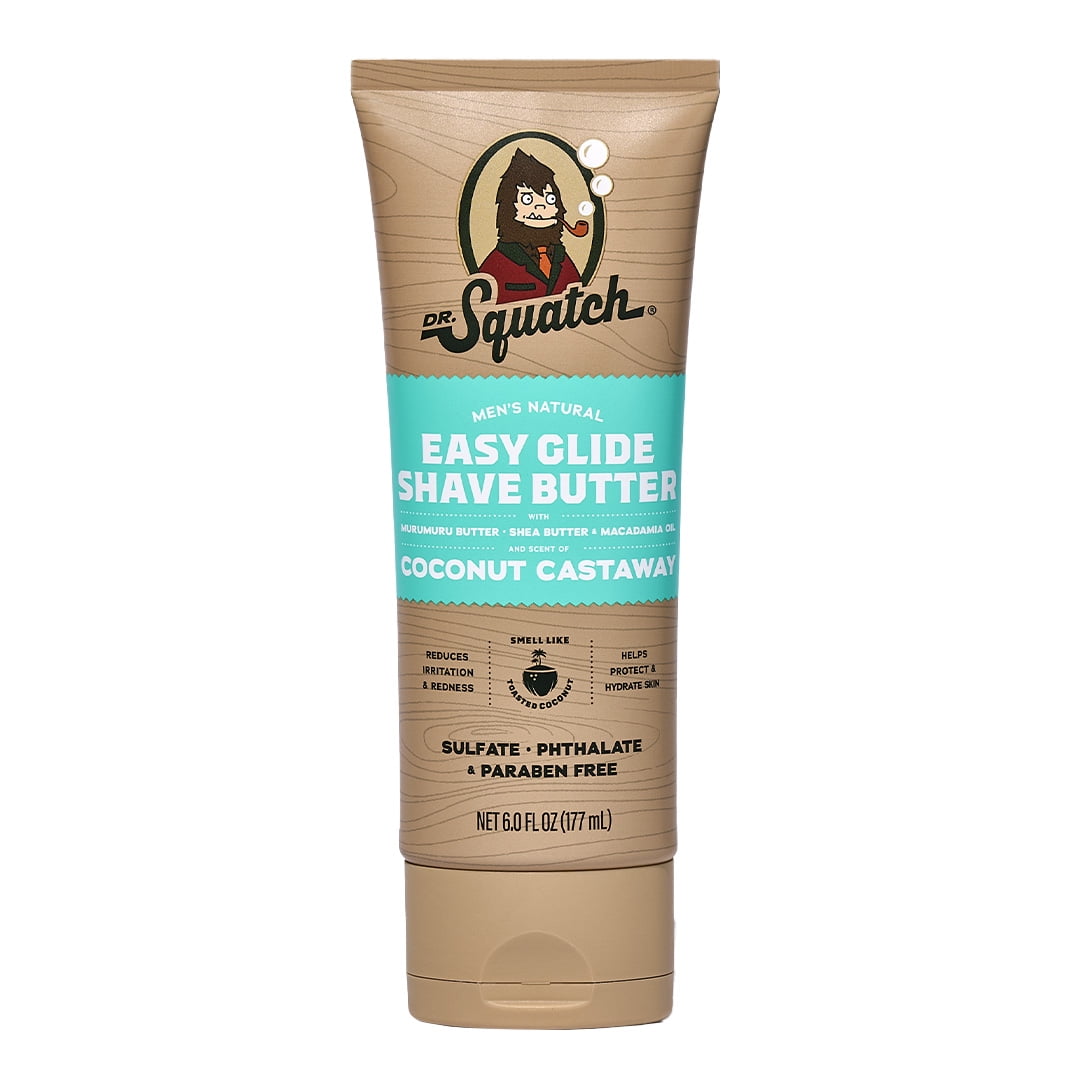
Dr. Squatch Mens Moisturizing Shave Butter Easy Glide Natural Thick & Creamy Shaving Butter for Men Coconut Castaway 6 fl Oz
At a glance
Summary
This shaving butter features a range of beneficial natural ingredients such as shea butter, murumuru seed butter, and macadamia seed oil, which provide excellent moisturizing and skin-soothing properties. The product avoids harsh chemicals and uses mild surfactants like coco-glucoside and sodium cocoyl glutamate, contributing to its gentle formulation. However, the presence of naturally derived fragrance, which can be a potential irritant, slightly detracts from its overall safety profile. Its plastic packaging can shed microplastics into the product and lowers its score.
Key ingredients 29
Butyrospermum Parkii (Shea) ButterVery Good
Shea Butter is a natural fat extracted from the nuts of the shea tree. It is highly moisturizing and helps to soothe and protect the skin. It is considered safe and beneficial for all skin types.
Risks
There are minimal risks, though individuals with nut allergies should patch test before use.
Benefits
It provides deep hydration and nourishment to the skin, improving elasticity and softness.
Astrocaryum Murumuru Seed ButterVery Good
Murumuru Seed Butter is a natural emollient that helps to moisturize and soften the skin. It is rich in fatty acids and is considered safe for use in cosmetics. It is beneficial for dry and sensitive skin.
Risks
There are minimal risks, though individuals with nut allergies should patch test before use.
Benefits
It provides intense hydration and helps to restore skin barrier function.
Macadamia Ternifolia Seed OilVery Good
Macadamia Seed Oil is a natural oil rich in fatty acids and antioxidants. It helps to moisturize and protect the skin. It is considered safe and beneficial for all skin types.
Risks
There are minimal risks, though individuals with nut allergies should patch test before use.
Benefits
It provides nourishment and helps to improve skin elasticity and hydration.
Coco-GlucosideGood
Coco-Glucoside is a mild surfactant derived from coconut oil and glucose. It is used to gently cleanse the skin without stripping natural oils. It is considered safe and non-irritating.
Risks
There are minimal risks associated with Coco-Glucoside, though very sensitive skin may experience mild irritation.
Benefits
It helps to cleanse the skin gently and is biodegradable, making it environmentally friendly.
GlycerinGood
Glycerin is a humectant that attracts moisture to the skin, helping to keep it hydrated. It is widely used in cosmetics for its moisturizing properties. It is considered safe and beneficial for all skin types.
Risks
There are minimal risks associated with glycerin, though it may cause stickiness in high concentrations.
Benefits
It helps to maintain skin hydration and improve skin barrier function.
Sodium Cocoyl GlutamateGood
Sodium Cocoyl Glutamate is a mild surfactant derived from coconut oil and glutamic acid. It is used for its gentle cleansing properties. It is considered safe and non-irritating.
Risks
There are minimal risks, though very sensitive skin may experience mild irritation.
Benefits
It provides gentle cleansing and is biodegradable, making it environmentally friendly.
Water (Aqua)Neutral
Water is a common solvent used in cosmetic formulations. It helps dissolve other ingredients and provides a base for the product. It is generally considered safe and non-irritating.
Risks
There are no significant risks associated with water in cosmetics.
Benefits
Water helps to hydrate the skin and improve the texture of the product.
Sodium Decylglucosides HydroxypropylsulfonateNeutral
This ingredient is a surfactant used for its cleansing properties. It is derived from natural sources and is considered mild. It is generally safe for use in cosmetics.
Risks
There is a low risk of irritation, especially for sensitive skin types.
Benefits
It provides effective cleansing while being gentle on the skin.
Myristic AcidNeutral
Myristic Acid is a fatty acid used as an emulsifier and cleansing agent. It helps to stabilize formulations and improve texture. It is generally considered safe for use in cosmetics.
Risks
In rare cases, it may cause mild irritation or allergic reactions.
Benefits
It helps to improve the texture and stability of cosmetic products.
Palmitic AcidNeutral
Palmitic Acid is a fatty acid used as an emulsifier and thickening agent in cosmetics. It helps to stabilize formulations and improve texture. It is generally considered safe for use.
Risks
In rare cases, it may cause mild irritation or allergic reactions.
Benefits
It helps to improve the texture and stability of cosmetic products.
PropanediolNeutral
Propanediol is a glycol used as a solvent and skin-conditioning agent. It helps to improve the texture and spreadability of products. It is generally considered safe for use in cosmetics.
Risks
There is a low risk of irritation, especially for sensitive skin types.
Benefits
It enhances the texture and feel of cosmetic formulations.
Stearic AcidNeutral
Stearic Acid is a fatty acid used as an emulsifier and thickening agent. It helps to stabilize formulations and improve texture. It is generally considered safe for use in cosmetics.
Risks
In rare cases, it may cause mild irritation or allergic reactions.
Benefits
It helps to improve the texture and stability of cosmetic products.
Microcrystalline CelluloseNeutral
Microcrystalline Cellulose is used as a thickening agent and stabilizer in cosmetics. It helps to improve the texture and consistency of products. It is generally considered safe for use.
Risks
There are minimal risks associated with its use in cosmetics.
Benefits
It helps to stabilize formulations and improve product texture.
Saccharide IsomerateNeutral
Saccharide Isomerate is a plant-derived moisturizer that binds to the skin to provide long-lasting hydration. It is considered safe for use in cosmetics. It is beneficial for maintaining skin moisture levels.
Risks
There are minimal risks associated with its use in cosmetics.
Benefits
It helps to maintain skin hydration and improve skin texture.
Citric AcidNeutral
Citric Acid is used to adjust the pH of cosmetic formulations. It is derived from citrus fruits and is considered safe for use. It helps to maintain the stability and effectiveness of the product.
Risks
In high concentrations, it may cause skin irritation or sensitivity.
Benefits
It helps to balance the pH of the product, enhancing its stability and performance.
Cetearyl AlcoholNeutral
Cetearyl Alcohol is a fatty alcohol used as an emulsifier and thickening agent. It helps to stabilize formulations and improve texture. It is generally considered safe for use in cosmetics.
Risks
There are minimal risks, though very sensitive skin may experience mild irritation.
Benefits
It helps to improve the texture and stability of cosmetic products.
Cetyl StearateNeutral
Cetyl Stearate is an ester used as an emollient and thickening agent in cosmetics. It helps to improve the texture and spreadability of products. It is generally considered safe for use.
Risks
There are minimal risks associated with its use in cosmetics.
Benefits
It enhances the texture and feel of cosmetic formulations.
EthylhexylglycerinNeutral
Ethylhexylglycerin is used as a preservative and skin-conditioning agent. It helps to enhance the efficacy of other preservatives. It is generally considered safe for use in cosmetics.
Risks
There is a low risk of irritation, especially for sensitive skin types.
Benefits
It helps to preserve the product and improve skin feel.
Titanium DioxideNeutral
Titanium Dioxide is used as a pigment and UV filter in cosmetics. It helps to provide coverage and protection from UV radiation. It is generally considered safe for use in cosmetics.
Risks
Inhalation of fine particles may pose respiratory risks, but this is less of a concern in cream formulations.
Benefits
It provides UV protection and enhances product coverage.
Acacia Senegal GumNeutral
Acacia Senegal Gum is a natural gum used as a thickening agent and stabilizer. It helps to improve the texture and consistency of products. It is generally considered safe for use in cosmetics.
Risks
There are minimal risks associated with its use in cosmetics.
Benefits
It helps to stabilize formulations and improve product texture.
Cetyl AlcoholNeutral
Cetyl Alcohol is a fatty alcohol used as an emulsifier and thickening agent. It helps to stabilize formulations and improve texture. It is generally considered safe for use in cosmetics.
Risks
There are minimal risks, though very sensitive skin may experience mild irritation.
Benefits
It helps to improve the texture and stability of cosmetic products.
Glycol DistearateNeutral
Glycol Distearate is used as an opacifying agent and emulsifier in cosmetics. It helps to improve the texture and appearance of products. It is generally considered safe for use.
Risks
There are minimal risks associated with its use in cosmetics.
Benefits
It enhances the texture and appearance of cosmetic formulations.
Xanthan GumNeutral
Xanthan Gum is a natural thickening agent used to stabilize cosmetic formulations. It helps to improve the texture and consistency of products. It is generally considered safe for use in cosmetics.
Risks
There are minimal risks associated with its use in cosmetics.
Benefits
It helps to stabilize formulations and improve product texture.
Cellulose GumNeutral
Cellulose Gum is used as a thickening agent and stabilizer in cosmetics. It helps to improve the texture and consistency of products. It is generally considered safe for use.
Risks
There are minimal risks associated with its use in cosmetics.
Benefits
It helps to stabilize formulations and improve product texture.
Tetrasodium Glutamate DiacetateNeutral
Tetrasodium Glutamate Diacetate is a chelating agent used to enhance the efficacy of preservatives. It helps to stabilize formulations and improve product performance. It is generally considered safe for use in cosmetics.
Risks
There are minimal risks associated with its use in cosmetics.
Benefits
It enhances the stability and effectiveness of cosmetic formulations.
Sodium CitrateNeutral
Sodium Citrate is used to adjust the pH of cosmetic formulations. It is derived from citric acid and is considered safe for use. It helps to maintain the stability and effectiveness of the product.
Risks
In high concentrations, it may cause skin irritation or sensitivity.
Benefits
It helps to balance the pH of the product, enhancing its stability and performance.
Naturally Derived FragranceBad
Fragrance, even when naturally derived, can cause allergic reactions and skin irritation. It is often a mixture of various compounds, some of which may be sensitizing. It is considered a common irritant in cosmetics.
Risks
Fragrance can cause skin irritation, allergic reactions, and may trigger asthma in sensitive individuals.
Benefits
It provides a pleasant scent to the product, enhancing user experience.
Sodium BenzoateBad
Synthetic preservative that can form benzene in the presence of vitamin C.
Risks
There is a low risk of irritation, especially for sensitive skin types.
Benefits
It helps to preserve the product and prevent spoilage.
Potassium SorbateBad
Synthetic preservative — flagged in daily-use products.
Risks
There is a low risk of irritation, especially for sensitive skin types.
Benefits
It helps to preserve the product and prevent spoilage.
Processing
Processed Foods
Get the full breakdown in the Scout appTake Scout shopping
Scan any product to see lab results, healthy alternatives, and your personalized analysis.
Amazon pricing & content
CERTAIN CONTENT THAT APPEARS ON THIS SITE COMES FROM AMAZON. THIS CONTENT IS PROVIDED “AS IS” AND IS SUBJECT TO CHANGE OR REMOVAL AT ANY TIME.