
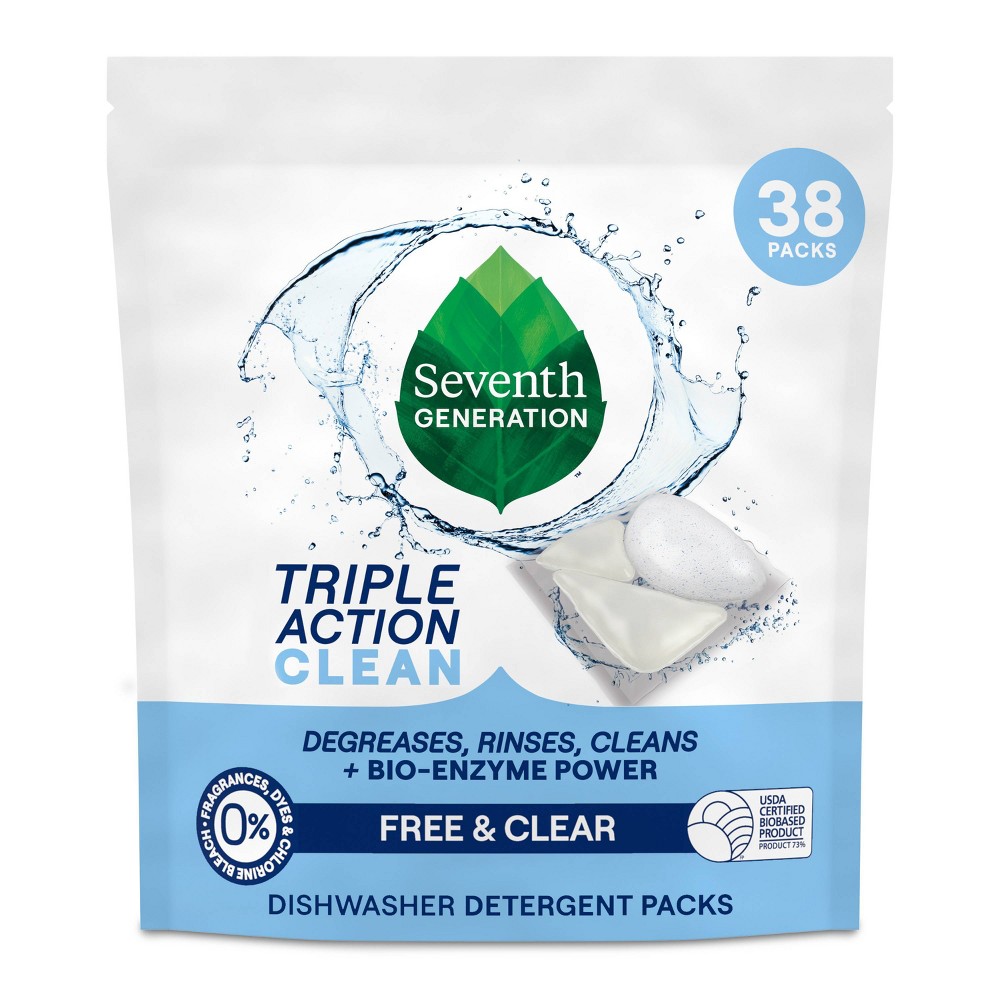


Seventh Generation Triple Action Clean Dishwasher Detergent Packets - 38ct: No Fragrance Added, Dye-Free, Bleach-Free
Analysis updated August 2026 · How Scout scores
At a glance
Summary
This dishwasher detergent is free from fragrances, dyes, and bleach, which are positive attributes for safety and environmental impact. It includes beneficial ingredients like citric acid and enzyme blends that enhance cleaning power and are biodegradable. However, the presence of benzisothiazolinone, a preservative that can cause skin sensitization and allergic reactions, slightly reduces its overall safety profile.
Key ingredients 17
protease enzyme blendVery Good
Protease enzymes break down proteins, enhancing the cleaning power of detergents. They are biodegradable and derived from natural sources. They pose minimal risk and are generally non-irritating.
Risks
Generally non-irritating but can cause mild irritation in sensitive individuals.
Benefits
Biodegradable and enhances cleaning power by breaking down proteins.
amylase enzyme blendVery Good
Amylase enzymes break down starches, enhancing the cleaning power of detergents. They are biodegradable and derived from natural sources. They pose minimal risk and are generally non-irritating.
Risks
Generally non-irritating but can cause mild irritation in sensitive individuals.
Benefits
Biodegradable and enhances cleaning power by breaking down starches.
sodium carbonateNeutral
Sodium carbonate is a common cleaning agent used to soften water and enhance the effectiveness of detergents. It is generally considered safe for use in cleaning products. However, it can be irritating to the skin and eyes in concentrated forms.
Risks
Potential skin and eye irritation if not handled properly.
Benefits
Helps to soften water and improve cleaning efficiency.
sodium citrateNeutral
Sodium citrate is used as a water softener and pH regulator in cleaning products. It is derived from citric acid and is generally considered safe. It poses minimal risk but can cause mild irritation in sensitive individuals.
Risks
May cause mild irritation if in contact with skin or eyes.
Benefits
Acts as a water softener and helps maintain product stability.
waterNeutral
Water is used as a solvent in many cleaning products, helping to dissolve other ingredients. It is essential for the formulation of liquid and gel products. There are no significant risks associated with water in cleaning products.
Benefits
Acts as a solvent and carrier for other ingredients.
tetrasodium glutamate diacetateNeutral
Tetrasodium glutamate diacetate is a chelating agent that helps to bind metal ions, improving cleaning efficiency. It is considered safe for use in cleaning products. It poses minimal risk but can cause mild irritation in sensitive individuals.
Risks
May cause mild irritation if in contact with skin or eyes.
Benefits
Improves cleaning efficiency by binding metal ions.
citric acidNeutral
Common acidulant and preservative — safe at typical use levels, neither beneficial nor harmful.
Risks
Generally non-irritating but can cause mild irritation in sensitive individuals.
Benefits
Biodegradable and enhances cleaning power by adjusting pH.
polyvinyl alcoholNeutral
Polyvinyl alcohol is used as a film-forming agent in detergent packets. It is water-soluble and considered safe for use in cleaning products. It poses minimal risk but can cause mild irritation if in contact with skin or eyes.
Risks
May cause mild irritation if in contact with skin or eyes.
Benefits
Acts as a film-forming agent, allowing for convenient packaging.
sodium sulfateNeutral
Sodium sulfate is used as a filler and thickening agent in cleaning products. It is generally considered safe and poses minimal risk. However, it can cause mild irritation if in contact with skin or eyes.
Risks
May cause mild irritation if in contact with skin or eyes.
Benefits
Acts as a filler and thickening agent, enhancing product consistency.
C12-16 alcohols ethoxylated propoxylatedNeutral
C12-16 alcohols ethoxylated propoxylated are surfactants used to enhance cleaning power. They are generally considered safe but can cause mild irritation in sensitive individuals. They pose minimal risk when used as directed.
Risks
May cause mild irritation if in contact with skin or eyes.
Benefits
Enhances cleaning power by acting as a surfactant.
sodium percarbonateNeutral
Sodium percarbonate is an oxygen-based bleaching agent used to enhance cleaning power. It is considered safer than chlorine bleach and is biodegradable. It poses minimal risk but can cause mild irritation if in contact with skin or eyes.
Risks
May cause mild irritation if in contact with skin or eyes.
Benefits
Acts as a safer, biodegradable bleaching agent.
sodium polyaspartateNeutral
Sodium polyaspartate is a biodegradable polymer used to prevent redeposition of soil. It is considered safe for use in cleaning products. It poses minimal risk but can cause mild irritation if in contact with skin or eyes.
Risks
May cause mild irritation if in contact with skin or eyes.
Benefits
Prevents redeposition of soil, enhancing cleaning efficiency.
sodium silicateNeutral
Sodium silicate is used as a corrosion inhibitor and to enhance cleaning power. It is generally considered safe but can cause mild irritation if in contact with skin or eyes. It poses minimal risk when used as directed.
Risks
May cause mild irritation if in contact with skin or eyes.
Benefits
Acts as a corrosion inhibitor and enhances cleaning power.
sorbitolNeutral
Sorbitol is used as a humectant and stabilizer in cleaning products. It is generally considered safe and poses minimal risk. However, it can cause mild irritation if in contact with skin or eyes.
Risks
May cause mild irritation if in contact with skin or eyes.
Benefits
Acts as a humectant and stabilizer, enhancing product stability.
xanthan gumNeutral
Xanthan gum is used as a thickening agent in cleaning products. It is derived from natural sources and is generally considered safe. It poses minimal risk but can cause mild irritation if in contact with skin or eyes.
Risks
May cause mild irritation if in contact with skin or eyes.
Benefits
Acts as a thickening agent, enhancing product consistency.
dipropylene glycolNeutral
Dipropylene glycol is used as a solvent and stabilizer in cleaning products. It is generally considered safe but can cause mild irritation if in contact with skin or eyes. It poses minimal risk when used as directed.
Risks
May cause mild irritation if in contact with skin or eyes.
Benefits
Acts as a solvent and stabilizer, enhancing product stability.
benzisothiazolinoneBad
Benzisothiazolinone is a preservative used to prevent microbial growth in cleaning products. It is effective but can cause skin sensitization and allergic reactions in some individuals. It poses a risk of irritation and allergic reactions.
Risks
Can cause skin sensitization and allergic reactions.
Benefits
Prevents microbial growth, extending product shelf life.
Get the full breakdown in the Scout appTake Scout shopping
Scan any product to see lab results, healthy alternatives, and your personalized analysis.
Download on theApp Store GET IT ONGoogle PlayAmazon pricing & content
Amazon price as of . Product prices and availability are accurate as of the date/time indicated and are subject to change. Any price and availability information displayed on Amazon.com at the time of purchase will apply to the purchase of this product.
CERTAIN CONTENT THAT APPEARS ON THIS SITE COMES FROM AMAZON. THIS CONTENT IS PROVIDED “AS IS” AND IS SUBJECT TO CHANGE OR REMOVAL AT ANY TIME.