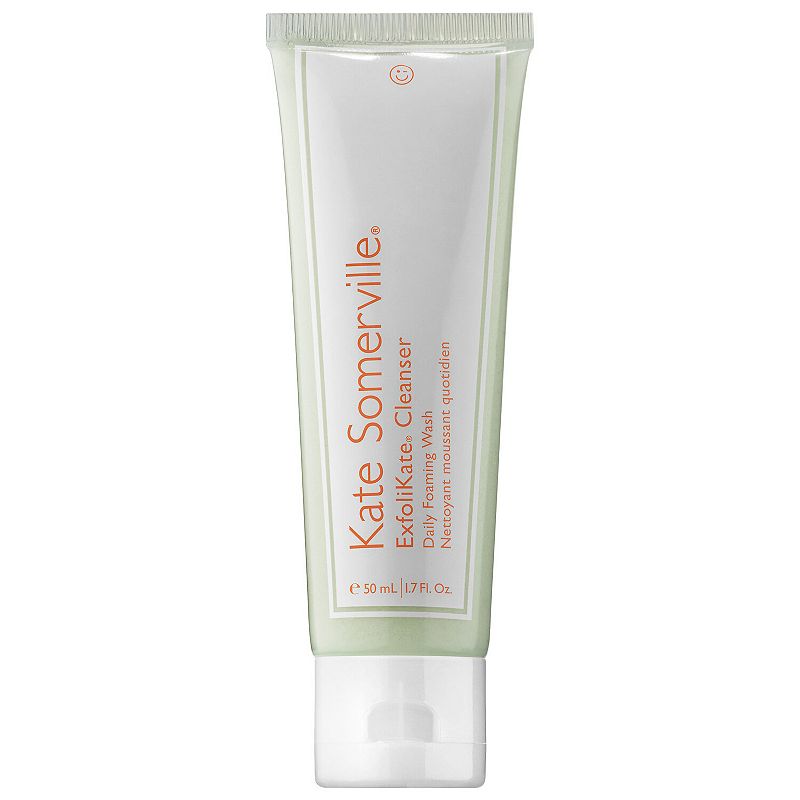
Kate Somerville ExfoliKate Exfoliating Cleanser Daily Foaming Wash 4 Fl Oz
At a glance
Summary
This face wash contains a blend of beneficial ingredients like glycerin, which hydrates the skin, and natural enzymes such as bromelain and papain for gentle exfoliation. The presence of mild surfactants like sodium cocoyl glycinate ensures effective cleansing without harshness. However, the inclusion of chlorphenesin, a preservative that can cause irritation in sensitive individuals, slightly lowers the overall safety profile. Its plastic packaging can shed microplastics into the product and lowers its score.
Key ingredients 35
Aloe Barbadensis Leaf Juice PowderVery Good
Aloe Barbadensis Leaf Juice Powder is derived from aloe vera and is known for its soothing and hydrating properties. It helps to calm irritated skin and provide moisture. It is suitable for all skin types and is widely used for its skin-soothing benefits.
Risks
There are minimal risks associated with this ingredient.
Benefits
It provides soothing and hydrating benefits to the skin.
Sodium Cocoyl GlycinateGood
Sodium Cocoyl Glycinate is a mild surfactant derived from coconut oil and glycine. It is known for its gentle cleansing properties and is less likely to irritate the skin compared to harsher surfactants. It helps to cleanse the skin without stripping natural oils.
Risks
There are minimal risks associated with this ingredient, though very sensitive skin may still react.
Benefits
It provides gentle cleansing and is suitable for sensitive skin types.
GlycerinGood
Glycerin is a humectant that attracts moisture to the skin, helping to maintain hydration. It is widely used in skincare for its moisturizing properties. It is suitable for all skin types and helps to improve skin barrier function.
Risks
There are no significant risks associated with glycerin in cosmetic formulations.
Benefits
It provides excellent moisturizing properties and supports skin hydration.
XylitylglucosideGood
Xylitylglucoside is a sugar-derived humectant that helps to retain moisture in the skin. It is known for its hydrating properties and ability to improve skin barrier function. It is suitable for all skin types and enhances skin hydration.
Risks
There are minimal risks associated with this ingredient.
Benefits
It provides hydration and supports the skin barrier.
XylitolGood
Xylitol is a sugar alcohol that acts as a humectant, helping to retain moisture in the skin. It is known for its hydrating properties and ability to improve skin barrier function. It is suitable for all skin types and enhances skin hydration.
Risks
There are minimal risks associated with this ingredient.
Benefits
It provides hydration and supports the skin barrier.
Leuconostoc/Radish Root Ferment FiltrateGood
Leuconostoc/Radish Root Ferment Filtrate is a natural preservative with antimicrobial properties. It helps to protect formulations from microbial contamination. It is derived from radish root and is considered a natural alternative to synthetic preservatives.
Risks
There are minimal risks associated with this ingredient.
Benefits
It provides natural antimicrobial protection for formulations.
BromelainGood
Bromelain is an enzyme derived from pineapple that helps to exfoliate the skin by breaking down proteins. It is known for its gentle exfoliating properties and ability to improve skin texture. It is suitable for most skin types and helps to promote a smoother complexion.
Risks
There is a risk of irritation for very sensitive skin types.
Benefits
It provides gentle exfoliation and improves skin texture.
PapainGood
Papain is an enzyme derived from papaya that helps to exfoliate the skin by breaking down proteins. It is known for its gentle exfoliating properties and ability to improve skin texture. It is suitable for most skin types and helps to promote a smoother complexion.
Risks
There is a risk of irritation for very sensitive skin types.
Benefits
It provides gentle exfoliation and improves skin texture.
Lactobacillus/Pumpkin Fruit Ferment FiltrateGood
Lactobacillus/Pumpkin Fruit Ferment Filtrate is a probiotic ingredient that helps to support the skin's microbiome. It is known for its soothing and hydrating properties. It is suitable for all skin types and helps to improve skin health.
Risks
There are minimal risks associated with this ingredient.
Benefits
It supports the skin's microbiome and provides hydration.
Glycolic AcidGood
Glycolic Acid is an alpha hydroxy acid (AHA) that helps to exfoliate the skin and improve texture. It is known for its ability to promote cell turnover and enhance skin radiance. It is suitable for most skin types and helps to improve the appearance of fine lines and uneven skin tone.
Risks
There is a risk of irritation for very sensitive skin types.
Benefits
It provides exfoliation and improves skin texture and radiance.
Aqua/Water/EauNeutral
Water is a common solvent used in cosmetics to dissolve other ingredients. It does not provide any direct benefits or risks in skincare formulations. It serves as a base for the formulation.
Risks
There are no inherent risks associated with water in cosmetic formulations.
Benefits
Water helps to dissolve other ingredients and provides a medium for application.
Stearic AcidNeutral
Stearic acid is a fatty acid used as an emulsifier and thickener in cosmetics. It helps to stabilize formulations and improve texture. It is generally considered safe for use in skincare products.
Risks
In rare cases, it may cause skin irritation in sensitive individuals.
Benefits
It helps to stabilize and thicken formulations, improving product texture.
Lauramidopropyl BetaineNeutral
Lauramidopropyl Betaine is a mild surfactant used to enhance foam and improve the texture of cleansing products. It is generally well-tolerated and helps to reduce irritation from other surfactants. It is commonly used in formulations for sensitive skin.
Risks
It may cause mild irritation in very sensitive skin types.
Benefits
It enhances foam and reduces irritation from other surfactants.
Hydroxypropyl Starch PhosphateNeutral
Hydroxypropyl Starch Phosphate is a modified starch used as a thickener and stabilizer in cosmetic formulations. It helps to improve the texture and consistency of products. It is generally considered safe for use in skincare.
Risks
There are minimal risks associated with this ingredient.
Benefits
It improves product texture and stability.
Cetearyl PhosphateNeutral
Cetearyl Phosphate is used as an emulsifier and surfactant in cosmetic formulations. It helps to blend oil and water components, improving product consistency. It is generally considered safe for use in skincare products.
Risks
There are minimal risks associated with this ingredient.
Benefits
It helps to emulsify and stabilize formulations.
Dimethicone PEG-8 MeadowfoamateNeutral
Dimethicone PEG-8 Meadowfoamate is a silicone-based conditioning agent that provides a smooth feel to the skin. It helps to improve the texture and spreadability of products. It is generally considered safe for use in cosmetics.
Risks
There are minimal risks, though some individuals may prefer to avoid silicones.
Benefits
It enhances product texture and provides a smooth application.
AnhydroxylitolNeutral
Anhydroxylitol is a sugar alcohol used as a humectant and skin conditioning agent. It helps to retain moisture in the skin and improve hydration. It is generally considered safe for use in skincare products.
Risks
There are minimal risks associated with this ingredient.
Benefits
It helps to maintain skin hydration and improve moisture retention.
Lauramide DIPANeutral
Lauramide DIPA is a surfactant used to enhance foam and improve the texture of cleansing products. It is generally well-tolerated and helps to reduce irritation from other surfactants. It is commonly used in formulations for sensitive skin.
Risks
It may cause mild irritation in very sensitive skin types.
Benefits
It enhances foam and reduces irritation from other surfactants.
Lactic AcidNeutral
Standard formulation ingredient — neither beneficial nor harmful at typical use.
Risks
There is a risk of irritation for very sensitive skin types.
Benefits
It provides exfoliation and improves skin texture and radiance.
Citrus Aurantium Bergamia (Bergamot) Fruit OilNeutral
Bergamot Fruit Oil is used for its fragrance and potential antibacterial properties. It can provide a pleasant scent to formulations. However, it may cause photosensitivity if not properly formulated.
Risks
It may cause photosensitivity and irritation if not properly formulated.
Benefits
It provides a pleasant scent and potential antibacterial properties.
Aniba Rosaeodora (Rosewood) Wood ExtractNeutral
Rosewood Wood Extract is used for its fragrance and potential skin-soothing properties. It can provide a pleasant scent to formulations. It is generally considered safe for use in cosmetics.
Risks
There are minimal risks associated with this ingredient.
Benefits
It provides a pleasant scent and potential skin-soothing properties.
Citrus Aurantium Dulcis (Orange) Peel OilNeutral
Orange Peel Oil is used for its fragrance and potential antibacterial properties. It can provide a pleasant scent to formulations. However, it may cause photosensitivity if not properly formulated.
Risks
It may cause photosensitivity and irritation if not properly formulated.
Benefits
It provides a pleasant scent and potential antibacterial properties.
Pelargonium Graveolens Flower OilNeutral
Pelargonium Graveolens Flower Oil, also known as geranium oil, is used for its fragrance and potential skin-soothing properties. It can provide a pleasant scent to formulations. It is generally considered safe for use in cosmetics.
Risks
There are minimal risks associated with this ingredient.
Benefits
It provides a pleasant scent and potential skin-soothing properties.
Benzyl BenzoateNeutral
Benzyl Benzoate is used as a fragrance ingredient and solvent in cosmetics. It is commonly used for its aromatic properties. It is generally considered safe for use in cosmetics.
Risks
It may cause irritation in sensitive individuals.
Benefits
It provides fragrance and acts as a solvent in formulations.
Sodium HydroxideNeutral
Sodium Hydroxide is used to adjust the pH of cosmetic formulations. It is a strong base that helps to neutralize acidic components. It is generally considered safe for use in cosmetics when used in small amounts.
Risks
It can be irritating in high concentrations.
Benefits
It helps to adjust the pH of formulations, ensuring product stability.
CitronellolNeutral
Citronellol is a fragrance component used for its rose-like scent. It is commonly used in cosmetics for its aromatic properties. It is generally considered safe for use in cosmetics.
Risks
It may cause irritation in sensitive individuals.
Benefits
It provides a rose-like scent to formulations.
MaltodextrinNeutral
Maltodextrin is used as a binding agent and stabilizer in cosmetics. It helps to improve the texture and consistency of products. It is generally considered safe for use in cosmetics.
Risks
There are minimal risks associated with this ingredient.
Benefits
It improves product texture and stability.
GeraniolNeutral
Geraniol is a fragrance component used for its rose-like scent. It is commonly used in cosmetics for its aromatic properties. It is generally considered safe for use in cosmetics.
Risks
It may cause irritation in sensitive individuals.
Benefits
It provides a rose-like scent to formulations.
CI 75810 (Chlorophyllin-Copper Complex)Neutral
Chlorophyllin-Copper Complex is used as a colorant in cosmetics. It provides a green hue to formulations and is derived from chlorophyll. It is generally considered safe for use in cosmetics.
Risks
There are minimal risks associated with this ingredient.
Benefits
It provides color to formulations and is derived from natural sources.
GlucoseBad
Processed additive flagged under Scout's ingredient doctrine.
Risks
There are minimal risks associated with this ingredient.
Benefits
It helps to maintain skin hydration and improve moisture retention.
CitralBad
Processed additive flagged under Scout's ingredient doctrine.
Risks
It may cause irritation in sensitive individuals.
Benefits
It provides a lemon-like scent to formulations.
Benzyl AlcoholBad
Processed additive flagged under Scout's ingredient doctrine.
Risks
It may cause irritation in sensitive individuals.
Benefits
It acts as a preservative and solvent, enhancing product stability.
LimoneneBad
Processed additive flagged under Scout's ingredient doctrine.
Risks
It may cause irritation in sensitive individuals.
Benefits
It provides a citrus scent to formulations.
ChlorphenesinBad
Chlorphenesin is a preservative used to prevent microbial growth in cosmetics. It is effective in low concentrations but may cause irritation in sensitive individuals. It is generally considered safe but has been associated with skin irritation.
Risks
It may cause skin irritation, especially in sensitive individuals.
Benefits
It acts as a preservative, enhancing product stability.
LinaloolBad
Processed additive flagged under Scout's ingredient doctrine.
Risks
It may cause irritation in sensitive individuals.
Benefits
It provides a floral scent to formulations.
Get the full breakdown in the Scout appTake Scout shopping
Scan any product to see lab results, healthy alternatives, and your personalized analysis.
Are you Kate Somerville? Fix an error Get the badge Get tested
Amazon pricing & content
Amazon price as of . Product prices and availability are accurate as of the date/time indicated and are subject to change. Any price and availability information displayed on Amazon.com at the time of purchase will apply to the purchase of this product.
CERTAIN CONTENT THAT APPEARS ON THIS SITE COMES FROM AMAZON. THIS CONTENT IS PROVIDED “AS IS” AND IS SUBJECT TO CHANGE OR REMOVAL AT ANY TIME.