
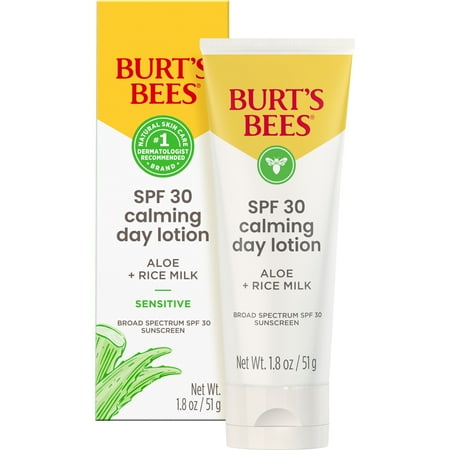

Burts Bees SPF 30 Calming Day Lotion with Aloe and Rice Milk for Sensitive Skin 1.8 Fluid Ounces
Analysis updated August 2026 · How Scout scores
At a glance
Summary
This product contains a blend of beneficial natural ingredients such as jojoba oil, aloe vera, and squalane, which are known for their moisturizing and soothing properties. However, the presence of denatured alcohol, which can be drying and irritating to the skin, slightly lowers its overall safety profile. The formulation is mostly clean, but the inclusion of this alcohol as a solvent affects its rating.
Key ingredients 45
SqualaneVery Good
Squalane is a highly effective emollient and natural antioxidant. It mimics the skin's natural oils.
Risks
Rarely causes irritation; generally safe for all skin types.
Benefits
Deeply moisturizes and helps to restore skin suppleness.
Carthamus Tinctorius (Safflower) Seed OilVery Good
Safflower Seed Oil is rich in linoleic acid, which helps to maintain the skin's barrier. It is a natural emollient.
Risks
Generally safe; may cause minor irritation in sensitive individuals.
Benefits
Moisturizes and nourishes the skin, improving texture.
Simmondsia Chinensis (Jojoba) Seed OilVery Good
Jojoba Oil is a natural emollient that closely resembles the skin's sebum. It is non-comedogenic and soothing.
Risks
Generally safe with low risk of irritation.
Benefits
Balances skin oil production and provides deep hydration.
Aloe Barbadensis Leaf JuiceVery Good
Aloe Vera is known for its soothing and hydrating properties. It helps to calm irritated skin.
Risks
Rarely causes allergic reactions; generally safe for use.
Benefits
Provides soothing relief and hydration to sensitive skin.
Argania Spinosa Kernel OilVery Good
Argan Oil is rich in essential fatty acids and vitamin E. It is a powerful moisturizer and antioxidant.
Risks
Generally safe with low risk of irritation.
Benefits
Nourishes and protects the skin, improving elasticity.
BeeswaxVery Good
Beeswax is a natural emollient and thickening agent. It helps to lock in moisture and protect the skin.
Risks
May cause allergic reactions in individuals sensitive to bee products.
Benefits
Provides a protective barrier and enhances skin hydration.
Caprylic/Capric TriglycerideGood
Caprylic/Capric Triglyceride is derived from coconut oil and glycerin. It is used as an emollient and helps to smooth and soften the skin.
Risks
Rarely, it may cause skin irritation in sensitive individuals.
Benefits
Enhances skin hydration and provides a silky feel.
GlycerinGood
Glycerin is a humectant that attracts moisture to the skin. It is widely used in skincare for its hydrating properties.
Risks
Generally considered safe with minimal risk of irritation.
Benefits
Helps maintain skin moisture and improves skin barrier function.
MicaGood
Beneficial ingredient — whole-food or functional value in this product class.
Risks
Inhalation of mica dust can be harmful, but topical use is generally safe.
Benefits
Provides a luminous finish to the skin.
InulinGood
Beneficial ingredient — whole-food or functional value in this product class.
Risks
Generally considered safe with minimal risk of irritation.
Benefits
Supports skin hydration and smoothness.
HoneyGood
Honey is a natural humectant and has antibacterial properties. It helps to retain moisture and soothe the skin.
Risks
Generally safe; may cause irritation in individuals allergic to bee products.
Benefits
Moisturizes and promotes skin healing.
Tocopheryl AcetateGood
Tocopheryl Acetate is a form of Vitamin E, an antioxidant that helps to protect the skin from free radical damage.
Risks
Generally safe; may cause minor irritation in sensitive individuals.
Benefits
Protects and nourishes the skin, improving overall health.
BisabololGood
Bisabolol is a natural compound known for its soothing and anti-inflammatory properties. It helps to calm irritated skin.
Risks
Generally safe with low risk of irritation.
Benefits
Reduces skin redness and irritation, promoting healing.
InositolGood
Beneficial ingredient — whole-food or functional value in this product class.
Risks
Generally considered safe with minimal risk of irritation.
Benefits
Enhances skin hydration and smoothness.
WaterNeutral
Water is a common solvent used in cosmetics to dissolve other ingredients. It helps in the application and absorption of the product. It does not have any direct benefits or risks.
Benefits
Provides a base for other ingredients to be absorbed effectively.
Polyglyceryl-6 StearateNeutral
Polyglyceryl-6 Stearate is an emulsifier that helps blend oil and water components. It stabilizes formulations.
Benefits
Improves product texture and consistency.
C13-15 AlkaneNeutral
C13-15 Alkane is used as an emollient and solvent in cosmetics. It provides a lightweight feel.
Risks
Generally considered safe with low risk of irritation.
Benefits
Contributes to a smooth application and non-greasy finish.
Pentylene GlycolNeutral
Pentylene Glycol is a synthetic humectant and solvent. It helps to retain moisture in the skin.
Risks
Low risk of irritation; generally safe for use.
Benefits
Enhances skin hydration and improves product preservation.
C15-19 AlkaneNeutral
C15-19 Alkane is used as an emollient and solvent. It helps to improve the texture of the product.
Risks
Considered safe with minimal risk of irritation.
Benefits
Contributes to a smooth and lightweight application.
SilicaNeutral
Silica is used as a thickening agent and absorbent. It helps to control oil and improve texture.
Risks
Inhalation of silica dust is harmful, but topical use is safe.
Benefits
Provides a matte finish and oil control.
Cetearyl NonanoateNeutral
Cetearyl Nonanoate is an ester used as an emollient. It provides a silky feel to the skin.
Risks
Low risk of irritation; generally safe for use.
Benefits
Enhances skin smoothness and product spreadability.
Polyhydroxystearic AcidNeutral
Polyhydroxystearic Acid is used as a thickening agent and emulsifier. It stabilizes formulations.
Benefits
Improves product texture and stability.
Saccharomyces FermentNeutral
Saccharomyces Ferment is used for its conditioning properties. It helps to improve skin texture.
Risks
Generally considered safe with minimal risk of irritation.
Benefits
Enhances skin smoothness and vitality.
Oryza Sativa (Rice) ExtractNeutral
Rice Extract is used for its soothing and conditioning properties. It helps to improve skin texture.
Risks
Generally considered safe with minimal risk of irritation.
Benefits
Supports skin smoothness and hydration.
Acacia Senegal GumNeutral
Acacia Senegal Gum is used as a thickening agent and stabilizer. It helps to improve product texture.
Risks
Generally considered safe with minimal risk of irritation.
Benefits
Enhances product consistency and application.
Polyglyceryl-6 BehenateNeutral
Polyglyceryl-6 Behenate is an emulsifier that helps to blend oil and water components. It stabilizes formulations.
Benefits
Improves product texture and consistency.
Stearyl AlcoholNeutral
Stearyl Alcohol is a fatty alcohol used as an emollient and thickener. It helps to soften and smooth the skin.
Risks
Generally considered safe with minimal risk of irritation.
Benefits
Enhances skin texture and product stability.
Cetyl AlcoholNeutral
Cetyl Alcohol is a fatty alcohol used as an emollient and thickener. It helps to soften and smooth the skin.
Risks
Generally considered safe with minimal risk of irritation.
Benefits
Improves skin texture and product consistency.
Xanthan GumNeutral
Xanthan Gum is used as a thickening agent and stabilizer. It helps to improve product texture.
Risks
Generally considered safe with minimal risk of irritation.
Benefits
Enhances product consistency and application.
Glyceryl LaurateNeutral
Glyceryl Laurate is used as an emulsifier and surfactant. It helps to blend ingredients and improve texture.
Risks
Generally considered safe with minimal risk of irritation.
Benefits
Improves product stability and application.
Sodium PCANeutral
Sodium PCA is a humectant that helps to retain moisture in the skin. It is naturally occurring in human skin.
Risks
Generally considered safe with minimal risk of irritation.
Benefits
Enhances skin hydration and smoothness.
Sodium CitrateNeutral
Sodium Citrate is used as a buffering agent to maintain pH balance. It helps to stabilize formulations.
Risks
Generally considered safe with minimal risk of irritation.
Benefits
Improves product stability and effectiveness.
Citric AcidNeutral
Citric Acid is used to adjust the pH of cosmetics. It also acts as a mild exfoliant.
Risks
May cause irritation in sensitive skin if used in high concentrations.
Benefits
Helps to maintain product stability and improve skin texture.
Sodium PhytateNeutral
Sodium Phytate is used as a chelating agent to stabilize formulations. It helps to prevent discoloration.
Risks
Generally considered safe with minimal risk of irritation.
Benefits
Enhances product stability and shelf life.
SucroseNeutral
Sucrose is a sugar used as a humectant. It helps to retain moisture in the skin.
Risks
Generally considered safe with minimal risk of irritation.
Benefits
Supports skin hydration and smoothness.
TrehaloseNeutral
Trehalose is a sugar used as a humectant. It helps to retain moisture in the skin.
Risks
Generally considered safe with minimal risk of irritation.
Benefits
Enhances skin hydration and smoothness.
Myristyl AlcoholNeutral
Myristyl Alcohol is a fatty alcohol used as an emollient and thickener. It helps to soften and smooth the skin.
Risks
Generally considered safe with minimal risk of irritation.
Benefits
Improves skin texture and product consistency.
Arachidyl AlcoholNeutral
Arachidyl Alcohol is a fatty alcohol used as an emollient and thickener. It helps to soften and smooth the skin.
Risks
Generally considered safe with minimal risk of irritation.
Benefits
Enhances skin texture and product stability.
Benzoic AcidNeutral
Benzoic Acid is used as a preservative to prevent microbial growth. It helps to extend product shelf life.
Risks
May cause minor irritation in sensitive individuals.
Benefits
Ensures product safety and longevity.
Potassium SorbateBad
Synthetic preservative — flagged in daily-use products.
Risks
May cause minor irritation in sensitive individuals.
Benefits
Ensures product safety and longevity.
FructoseBad
Processed additive flagged under Scout's ingredient doctrine.
Risks
Generally considered safe with minimal risk of irritation.
Benefits
Enhances skin hydration and smoothness.
GlucoseBad
Processed additive flagged under Scout's ingredient doctrine.
Risks
Generally considered safe with minimal risk of irritation.
Benefits
Supports skin hydration and smoothness.
Sodium BenzoateBad
Synthetic preservative that can form benzene in the presence of vitamin C.
Risks
May cause minor irritation in sensitive individuals.
Benefits
Ensures product safety and longevity.
PhenoxyethanolBad
Processed additive flagged under Scout's ingredient doctrine.
Risks
May cause irritation in sensitive individuals; generally considered safe in low concentrations.
Benefits
Ensures product safety and longevity.
Alcohol Denat.Very Bad
Denatured Alcohol is used as a solvent and astringent. It can be drying and irritating to the skin.
Risks
May cause dryness and irritation, especially in sensitive skin.
Benefits
Provides a quick-drying finish and helps other ingredients penetrate the skin.
Get the full breakdown in the Scout appTake Scout shopping
Scan any product to see lab results, healthy alternatives, and your personalized analysis.
Download on theApp Store GET IT ONGoogle PlayAmazon pricing & content
Amazon price as of . Product prices and availability are accurate as of the date/time indicated and are subject to change. Any price and availability information displayed on Amazon.com at the time of purchase will apply to the purchase of this product.
CERTAIN CONTENT THAT APPEARS ON THIS SITE COMES FROM AMAZON. THIS CONTENT IS PROVIDED “AS IS” AND IS SUBJECT TO CHANGE OR REMOVAL AT ANY TIME.