
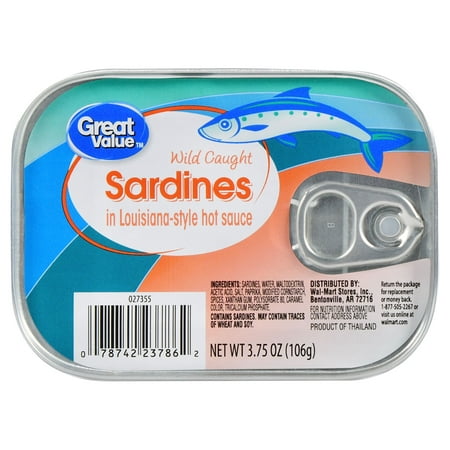



Great Value Wild Caught Sardines in Louisiana-style Hot Sauce, 3.75 oz
Great ValueAnalysis updated August 2026 · How Scout scores
Near you
Great Value is carried at Walmart stores. Find one within 25 miles.
At a glance
Summary
This product contains wild-caught sardines, which are a high-quality source of protein and omega-3 fatty acids, contributing positively to its nutritional profile. However, the presence of additives such as maltodextrin, polysorbate 80, and caramel color, along with its high processing level, significantly impacts its health rating. These additives and the ultra-processed nature of the product limit its overall score despite the beneficial ingredients.
Key ingredients 12
SardinesVery Good
Sardines are a high-quality source of protein and omega-3 fatty acids. They are minimally processed and provide essential nutrients like vitamin D and calcium. As a wild-caught fish, they are generally lower in contaminants compared to farmed fish.
Benefits
Rich in omega-3 fatty acids that support heart and brain health. Provides essential nutrients such as vitamin D and calcium.
PaprikaGood
Paprika is a spice made from ground peppers, providing flavor and color. It contains antioxidants and vitamins such as vitamin A. It is minimally processed and adds nutritional value to foods.
Benefits
Rich in antioxidants and vitamins, contributing to overall health.
Chili pasteNeutral
Chili paste adds flavor and spice to the product. It is composed of various ingredients, some of which are processed. The paste itself does not provide significant nutritional benefits or risks.
Benefits
Adds flavor and spice to the product, enhancing taste.
Acetic acidNeutral
Acetic acid is used as a preservative and flavoring agent. It is a component of vinegar and generally recognized as safe in small amounts. It does not provide significant nutritional benefits.
Benefits
Acts as a preservative and flavor enhancer in foods.
SaltNeutral
Salt is used for seasoning and preservation. It is a common culinary ingredient but does not provide additional nutritional benefits beyond sodium. Excessive consumption can lead to health issues such as hypertension.
Risks
Excessive salt intake can lead to high blood pressure and cardiovascular issues.
Benefits
Enhances flavor and acts as a preservative.
SpiceNeutral
Spice is a generic term for flavoring agents used in foods. The specific spices are not identified, making it difficult to assess their individual benefits or risks. Generally, spices add flavor without significant nutritional impact.
Benefits
Enhances flavor and may contain beneficial compounds depending on the specific spices used.
Xanthan gumNeutral
Xanthan gum is a polysaccharide used as a thickening and stabilizing agent. It is produced through fermentation and is generally recognized as safe. It does not provide significant nutritional benefits.
Risks
May cause digestive issues in sensitive individuals when consumed in large amounts.
Benefits
Improves texture and stability of food products.
Tricalcium phosphateNeutral
Tricalcium phosphate is used as an anti-caking agent and calcium supplement. It is generally recognized as safe and provides calcium, but in small amounts. It does not significantly impact the nutritional profile of the product.
Benefits
Provides a source of calcium, although in small amounts.
MaltodextrinBad
Maltodextrin is a highly processed carbohydrate used as a thickener or filler. It has a high glycemic index, which can spike blood sugar levels. It provides no nutritional benefits and is often used in processed foods.
Risks
May cause spikes in blood sugar levels and is not suitable for those with insulin sensitivity.
Modified corn starchBad
Modified corn starch is a processed carbohydrate used as a thickener. It is chemically altered and provides no nutritional benefits. It is often used in processed foods to improve texture.
Risks
May contribute to increased calorie intake without nutritional benefits.
Polysorbate 80Bad
Polysorbate 80 is an emulsifier used to improve texture and consistency. It is a synthetic compound and may cause allergic reactions in some individuals. It provides no nutritional benefits.
Risks
May cause allergic reactions or digestive issues in sensitive individuals.
Caramel colorBad
Caramel color is a food coloring agent used to enhance appearance. It is a processed additive and may contain contaminants like 4-MEI, which is a potential carcinogen. It provides no nutritional benefits.
Risks
May contain contaminants like 4-MEI, which is a potential carcinogen.
Processing
Ultra-Processed Foods
Get the full breakdown in the Scout appTake Scout shopping
Scan any product to see lab results, healthy alternatives, and your personalized analysis.
Download on theApp Store GET IT ONGoogle Play